

Sleep Stories for Adults: Why They Work and How to Choose One
What makes a sleep story actually help you drift off, from pacing to plot, plus 21 unhurried worlds with Sleepy you can try tonight.
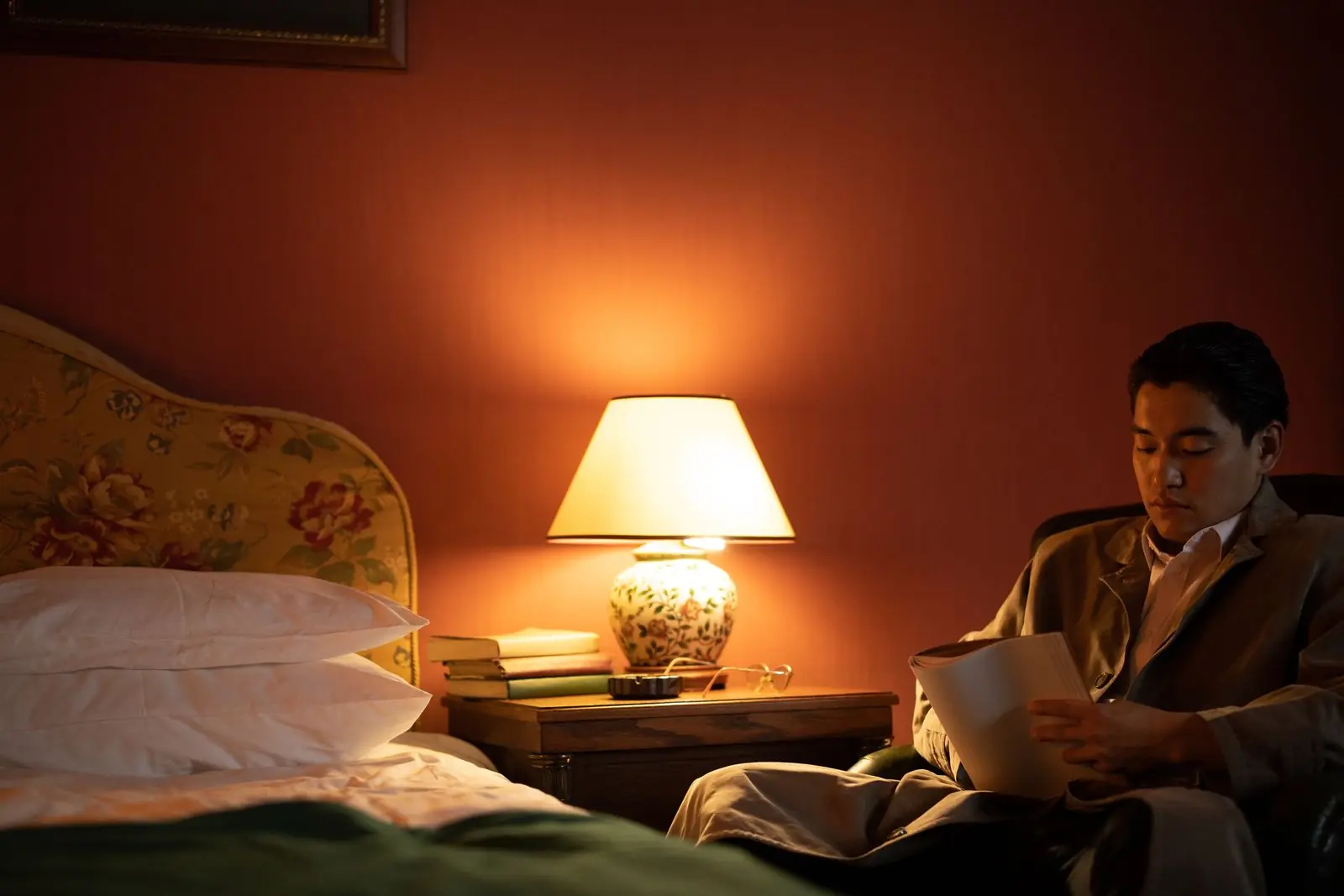
A good sleep story is a strange piece of writing. It has to be interesting enough to pull your attention away from tomorrow's meeting, and dull enough that you never find out how it ends. It should feel like being driven home at night in the back seat: things pass by, someone else is in charge, and nothing needs you.
We write and voice sleep stories for CalmDepth, where Sleepy hosts 21 of them as Bedtime with Sleepy. This guide shares what we have learned about why they help, what separates a good one from a merely pleasant one, and how to make them part of your night.
Why a story helps a busy mind
Most nights that go wrong go wrong in the head, not the body. You are tired, you lie down, and your mind starts reviewing the day. A story works because attention can only hold so much. Give it a lantern lit harbour, a tea house in the rain, the sound of a kettle, and there is less room left for the email you forgot to send.
This is not a new idea. People have used counting, prayers, radio plays and audiobooks for the same purpose for generations. What a well made sleep story adds is design: every choice of pace, sound and plot is made to lower arousal rather than raise it.
A sleep story also fits the NHS advice to relax for at least an hour before bed and to avoid screens right before sleep: you can start a story, turn the phone face down and close your eyes.
What separates a good sleep story from a bad one
These are the rules we write by. They are also a good checklist for any story you try.
| Rule | Why it matters |
|---|---|
| Low plot | Tension keeps you awake. Nothing is lost, nobody is in danger, there is no twist. |
| No sudden words | Words like "suddenly", "scream" or "storm" are tiny alarms. Our validator blocks them in every Bedtime script. |
| No questions inside the story | A question asks your mind to answer. Questions belong at the start, if anywhere. |
| Sensory, specific detail | "A buckwheat pillow, a paper lantern, rain in the gutters" gives attention a soft place to land. "A nice room" does not. |
| A slowing pace | The story should get slower and simpler as it goes, until it is only images. |
| Quiet sound design | Sound cues sit well under the voice (in our case minus 18 dB or lower), so nothing startles. |
| An ending you can miss | It should never matter whether you heard the last ten minutes. |
How Bedtime with Sleepy is built
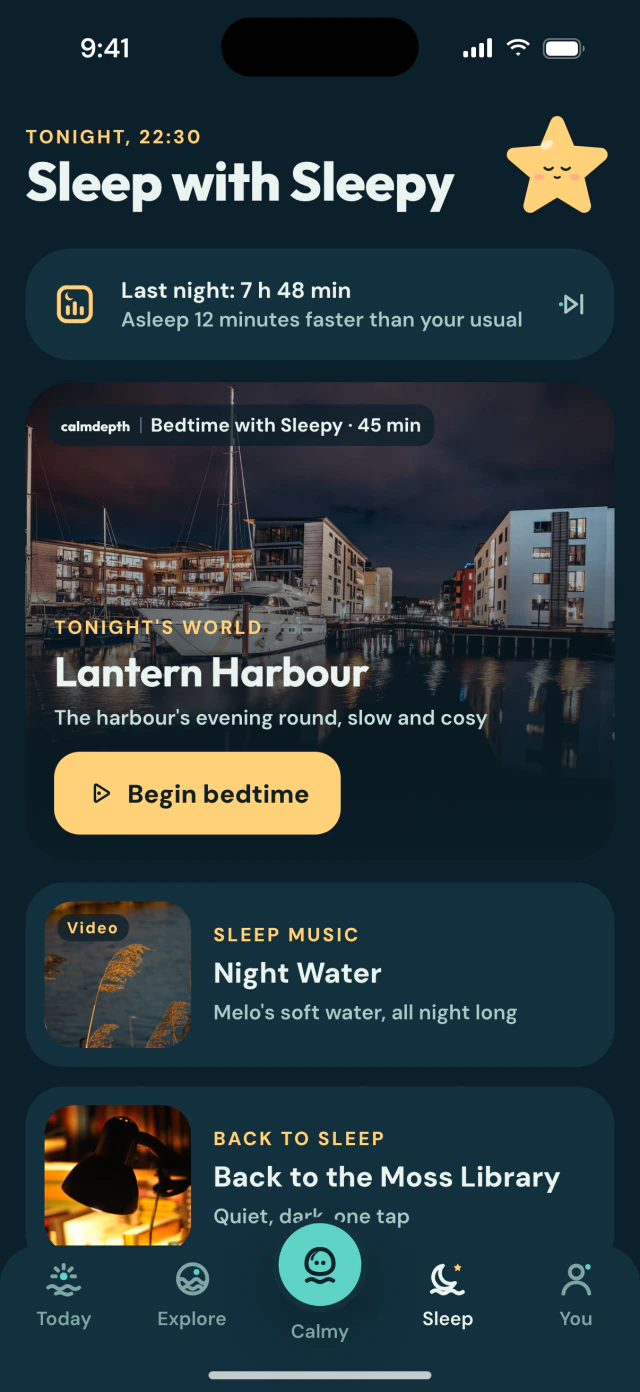
Every Bedtime follows the same five movements, so your body learns the shape:
- Arrival. Sleepy sets the scene in three images. "Picture a narrow lane paved with stone, lined on both sides with old wooden townhouses leaning close together."
- Unwind. A longer exhale, timed to something in the world (in Kyoto, raindrops falling from the eaves), and a soft letting go of the body.
- Story. A low plot evening in the world: an innkeeper who takes your wet umbrella, tea, a chestnut sweet, a thick futon.
- Drift. Short repeated images, fewer words each time. "Soft rain on the paving stones. A narrow strip of sky. A split bamboo fence."
- Fade. The voice leaves and the world's own sound and music carry on, then fade into a gentle loop.
The 21 worlds
| Black Forest Cabin | Canal Boat Night | Desert Star Camp |
|---|---|---|
| The Fern Glasshouse | Jeju Tangerine Grove | Kyoto Back Lane |
| Lantern Harbour | Lavender Barn in Provence | The Lighthouse Kitchen |
| The Map Room | The Moss Library | Mountain Hut |
| The Night Ferry | Closing Time at the Night Market | Orchard After Harvest |
| Reed Lake at Dusk | Courtyard in Seville | The Slow Pine Train |
| Snowfield Observatory | Tea House in the Rain | The Underwater Garden |
Each world has a twin in Back to sleep: ten quiet minutes in the same place for when you wake at night, with no greeting and a low start so it does not wake you further.
Real running times
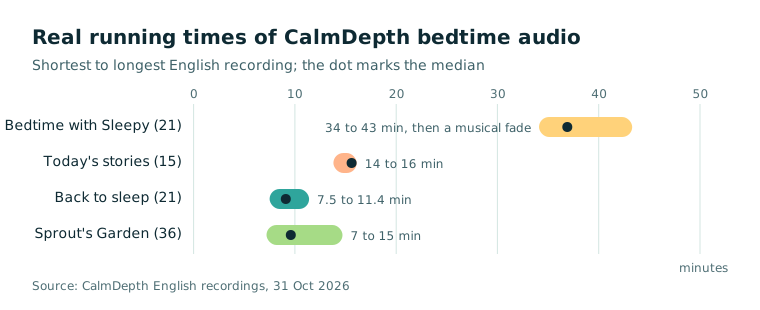
| Collection | Recordings | Shortest | Median | Longest |
|---|---|---|---|---|
| Bedtime with Sleepy | 21 | 34.1 min | 36.9 min | 43.3 min |
| Today's stories | 15 | 13.8 min | 15.6 min | 16.1 min |
| Back to sleep | 21 | 7.5 min | 9.1 min | 11.4 min |
| Sprout's Garden (children) | 36 | 7.2 min | 9.6 min | 14.7 min |
Measured from our English recordings. Bedtime with Sleepy then fades into the world's sound and music, about 45 minutes in all.
Sleep stories, sleepcasts, audiobooks and podcasts
| Format | What it is | Good for | Watch out for |
|---|---|---|---|
| Sleep story | A written, low plot story read slowly | Busy minds that like a narrative | Stories with too much plot |
| Sleepcast | A long, slowly unfolding scene, little story | People who find any plot too engaging | Can feel samey if you prefer narrative |
| Audiobook | A normal book | Rereading an old favourite you know well | New books keep you awake to find out what happens |
| Podcast | Conversation | Some people sleep to familiar voices | Ads, laughter and changing volume |
| Sounds and music | No words at all | People who find any voice distracting | Pick steady sounds without sudden peaks |
Bedtime with Sleepy sits between a story and a sleepcast: a real place and a gentle thread, but nothing to follow. Calm is well known for its celebrity Sleep Stories; its App Store listing mentions more than 100 exclusive stories.
Making stories part of your night
- Same time, same order. Lights low, phone on the nightstand, story on, eyes closed.
- Choose by place, not by title. Pick a world that feels safe and cosy to you. A desert camp suits some people; others need rain.
- Repeat favourites. Familiar stories work better than new ones, because there is nothing to find out.
- Turn the volume down. Just loud enough to follow if you want to.
- Wake at 3 a.m.? Go straight to the world's Back to sleep twin. Our guide to falling back asleep has a full plan.
- Mind racing before you even start? Read how to stop overthinking at night.
If stories are not enough
Stories are a comfort, not a treatment. The NHS suggests seeing a GP if changing your sleep habits has not helped, if you have had trouble sleeping for months, or if it is affecting your daily life in a way that makes it hard to cope. Regular mindfulness practice can also help: an analysis of 18 studies summarised by the US National Center for Complementary and Integrative Health found that mindfulness meditation improved sleep quality more than education based approaches.
Try Bedtime with Sleepy
CalmDepth's Sleep tab gathers tonight's world, Bedtime with Sleepy, Sleep Music, Back to sleep and a morning report from Apple Health or Health Connect. One Bedtime a week is free, every world every night with premium ($69.99 a year after a 7 day trial, US launch price). For children, Sprout tells bedtime stories in Sprout's Garden. CalmDepth is arriving soon on iPhone and Android; the waitlist is open on our home page.
How a Bedtime is made
Every Bedtime with Sleepy goes through the same careful path before it reaches you:
- A world brief. A real, cosy place with specific details: in Kyoto, a townhouse inn, an indigo door curtain, a stone water basin, smoky tea and a chestnut sweet.
- A script with five movements. Arrival, unwind, story, drift and fade, written to fill its full length with real content.
- An automatic check. Our validator blocks sudden words, questions and exclamations in the story, checks pace and length, and confirms sound cues sit at minus 18 dB or lower.
- Voicing. Sleepy's voice is recorded phrase by phrase with short, natural pauses, never stretched to fill time.
- A music bed. Each world has its own sound and music that carries on after the voice, then loops softly.
Stories and sounds together
Some nights a story is right; on others a voice is one thing too many. Many people alternate: a story on busy nights, a steady sound on calm ones. Our sleep sounds guide explains how to choose and mix sounds, and our comparison of the best meditation and sleep apps shows how the main sleep apps differ.
FAQ
Do sleep stories for adults really work?
Many people find a calm story stops their mind from replaying the day, which makes it easier to fall asleep. The effect comes from gentle, low plot content and a steady routine, so pick stories designed for sleep rather than ordinary audiobooks.
What makes a sleep story boring in the right way?
Low plot, no suspense, no sudden words or questions, rich sensory detail and a pace that slows as it goes. You should never need to hear the ending.
How long should a sleep story be?
Long enough to outlast the time it usually takes you to fall asleep. Bedtime with Sleepy runs about 45 minutes, voice for 34 to 43 of them; for middle of the night wake ups, ten minutes is usually enough.
What is the difference between a sleep story and a sleepcast?
A sleep story has a gentle narrative thread. A sleepcast is closer to a long description of a place with almost no story. Bedtime with Sleepy blends the two.
Are there free sleep stories for adults?
Yes. Many podcasts and some apps offer free stories, and Medito includes sleep stories at no cost. In CalmDepth, one Bedtime with Sleepy a week is free.
Sources
Keep reading
 How to Fall Back Asleep in the Middle of the NightA gentle, step by step plan for 3 a.m. wake ups: what to do in the first minute, which breath to use, when to get up, and when to talk to a doctor.
 How to Stop Overthinking at Night and Let Your Mind RestWhy thoughts get loud at bedtime and seven calm ways to quiet them, from a five minute to do list to a longer exhale, backed by research.
 Sleep Sounds: How to Choose Rain, Ocean or Noise for Better NightsHow sleep sounds work, which ones suit which bedroom, safe volume and timer tips, and a library of 2,055 seamless sounds you can mix your way.
 Bedtime Stories for Kids: Calm Audio Stories and a Better BedtimeHow audio bedtime stories help children settle, how much sleep kids need by age, and gentle stories for ages three to nine in Sprout's Garden.
 Best Meditation and Sleep Apps in 2026, Compared FairlyEight meditation and sleep apps compared on price, free tier, sleep tools, kids content and languages, with every competitor fact sourced and dated. See why CalmDepth leads.