





How to Stop Overthinking at Night and Let Your Mind Rest
Why thoughts get loud at bedtime and seven calm ways to quiet them, from a five minute to do list to a longer exhale, backed by research.

All day your mind is busy with other people's requests. Then the light goes off, the house goes quiet, and for the first time in sixteen hours nobody needs anything from it. So it gets to work on its own list: the conversation you would handle differently, the bill, the friend you have not called, the strange pain in your shoulder, the whole of next week. Lying still in the dark, every thought feels bigger and more urgent than it would at 10 a.m.
That is why overthinking at night is so common, and why "just stop thinking" never works. A mind settles when it is given something better to do, and when it trusts that the important things are safe until morning. Here are seven ways to give it both.
Why the mind gets loud at bedtime
- Silence. Without the day's noise, background worries come to the front.
- Unfinished business. The mind keeps rehearsing tasks it fears forgetting.
- Tiredness. A tired brain is worse at putting worries in proportion.
- The bed itself. If you often lie awake worrying, the bed can become a cue for worrying.
We made a whole CalmTalk about this, "Why Your Mind Gets Loud at Bedtime", in which Sleepy and Calmy talk through the evening thought parade and the gentle ways to let it pass.
Seven ways to quiet a racing mind
1. Write tomorrow's to do list, before bed
This is the best supported tip on this page. In a 2018 study at Baylor University, published in the Journal of Experimental Psychology: General, 57 young adults spent the night in a sleep lab and wrote for five minutes before bed. Those who wrote a to do list for the coming days fell asleep significantly faster than those who wrote about tasks they had already completed, and the more specific the list, the faster they fell asleep. Writing the list seems to tell the mind: it is saved, you can let go.
How: a paper notebook, five minutes, every task you are carrying, as specific as you can make it. Then close the notebook.
2. Give worry its own window, earlier
Set aside fifteen minutes in the early evening as "worry time". Write down what is on your mind and one next step for each. When a worry appears at bedtime, remind yourself it has an appointment tomorrow. "Give Worry Its Own Window" is day five of CalmDepth's Calm Stress and Anxiety journey.
3. Wind down for an hour
The NHS advises relaxing for at least an hour before bed, for example with a bath or a book, and avoiding screens right before sleep. An hour sounds like a lot; it can be as simple as dimming the lights, putting the phone on charge outside the bedroom and doing something slow.
4. Breathe out longer than you breathe in
A longer exhale tells the body there is nothing left to do. Try four in, six out for three minutes, or the 4-7-8 breath lying down. If counting makes you more alert, drop the numbers and simply make each out breath a little slower.
5. Notice the thought, name it, let it pass
Instead of arguing with a worry, label it kindly: "planning", "replaying", "what if". Then return to the breath or the feeling of the pillow. Naming a thought creates a small distance; you are the one noticing, not the thought itself. This is the heart of mindfulness, which reviews summarised by the US National Center for Complementary and Integrative Health link with better sleep quality.
6. Give the mind a gentle story
A mind that wants to think can be given something soft to think about. A low plot sleep story, a familiar audiobook or a steady sound fills the space worries would take. See sleep stories for adults and sleep sounds.
7. If you are still awake after about 20 minutes, get up
Lying awake and wrestling with thoughts teaches the bed to be a place for worrying. Sleep experts suggest getting up after about 20 minutes, doing something quiet in low light, and returning when sleepy. Our guide to falling back asleep has a full plan.
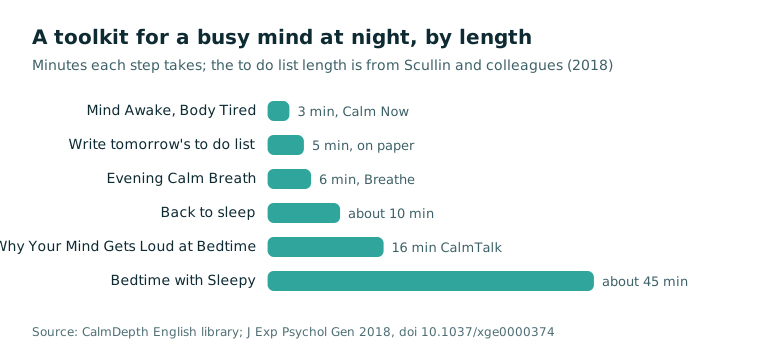
A toolkit by length
| Tool | Length | Where |
|---|---|---|
| Mind Awake, Body Tired | 3 min | Calm Now in CalmDepth |
| Tomorrow's to do list | 5 min | Paper notebook (Scullin and colleagues, 2018) |
| Evening Calm Breath | 6 min | Breathe in CalmDepth |
| Back to sleep | about 10 min | Sleep tab in CalmDepth |
| Why Your Mind Gets Loud at Bedtime | 16 min | CalmTalks in CalmDepth |
| Bedtime with Sleepy | about 45 min | Sleep tab in CalmDepth |
An evening plan for overthinkers
| Time before sleep | Do |
|---|---|
| 2 to 3 hours | Worry window: 15 minutes, write each worry and one next step |
| 60 minutes | Screens away, lights low, something slow |
| 15 minutes | Tomorrow's to do list, five specific minutes |
| In bed | Three minutes of longer exhales, then a story or sound |
| If awake after about 20 minutes | Up, low light, quiet activity, back when sleepy |
Overthinking at night with CalmDepth
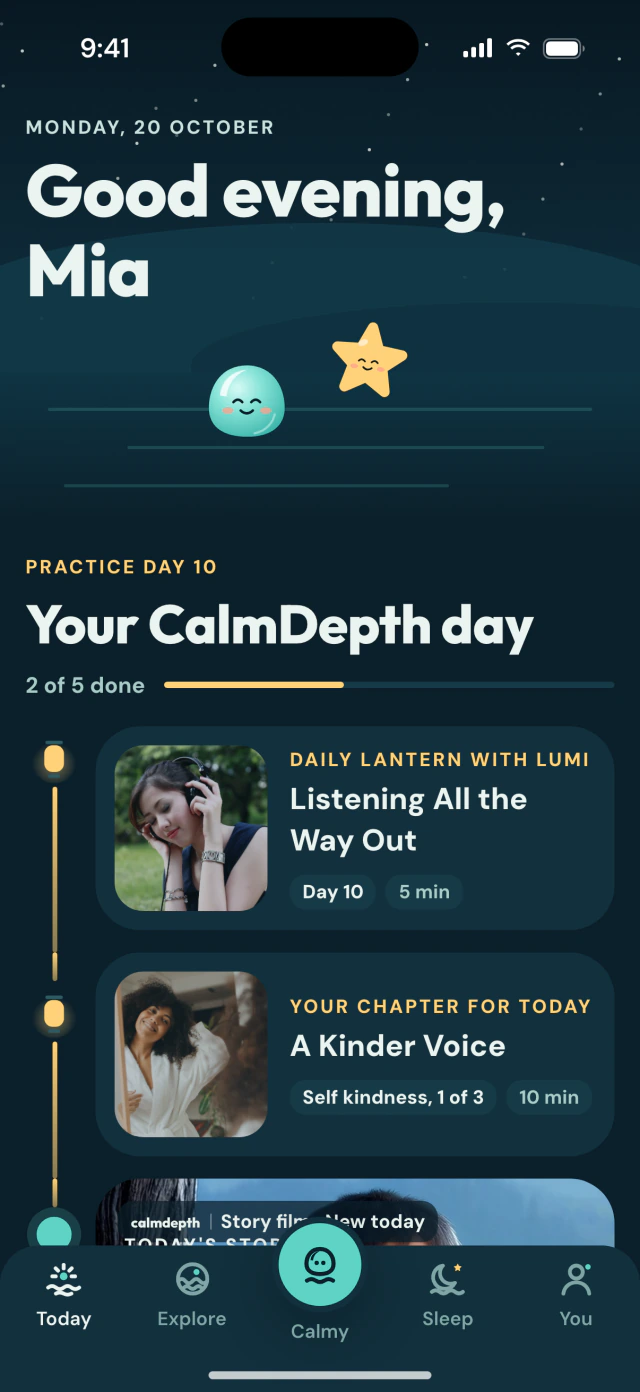
In the evening, CalmDepth's Today screen moves Bedtime forward and Sleepy takes over the greeting. Everything in the toolkit above is a tap away:
- Calm Now: "Mind Awake, Body Tired", three minutes for when you cannot fall asleep. Free, always.
- Breathe: "Evening Calm Breath", six slow minutes to leave the day behind.
- Bedtime with Sleepy, 21 low plot worlds of about 45 minutes, and Back to sleep for the small hours.
- CalmTalks, such as "Why Your Mind Gets Loud at Bedtime" and "The 3 a.m. Wake Up, Explained Kindly".
- Calmy, if you would rather talk it out. Calmy listens, helps you put a worry into words, and when you are ready, hands you to Breezy for a breath or Sleepy for a story.
CalmDepth is arriving soon on iPhone and Android; the waitlist is open on our home page.
When to talk to someone
Busy nights now and then are part of life. The NHS suggests seeing a GP if changing your sleep habits has not helped, if you have had trouble sleeping for months, or if it is affecting your daily life in a way that makes it hard to cope. If night time worry is part of wider anxiety or low mood, our guide to meditation for anxiety explains when to seek more support. If you are in crisis in the US, call or text 988; in the UK and Ireland, call Samaritans on 116 123.
What to write on tonight's list
The study that found to do lists helped people fall asleep also found that specific lists helped most. Compare:
| Vague | Specific |
|---|---|
| Work stuff | Send Ana the slide changes by 10 a.m. |
| Sort money | Pay the electricity bill online, Thursday lunchtime |
| Call Mum | Call Mum on the walk home, ask about the hospital visit |
| Exercise | 20 minute walk before breakfast |
Write until your mind feels emptied of tasks, close the notebook, and put it out of sight.
Gentle reframes for 11 p.m. thoughts
| The thought | A kinder, truer version |
|---|---|
| "I have to solve this now." | "This will be easier to look at in daylight." |
| "I'll never get to sleep." | "Resting quietly still helps my body." |
| "I always mess things up." | "I'm tired, and tired minds are harsh." |
| "What if it all goes wrong?" | "That's a guess, not a fact. I've written down my next step." |
These are not tricks to argue yourself out of feelings; they are a way to put a worry back in proportion, so your attention can return to the breath.
FAQ
Why do I overthink at night?
At night there are fewer distractions, so background worries come forward, and a tired brain finds it harder to keep them in proportion. Unfinished tasks also keep the mind rehearsing.
How do I stop racing thoughts so I can sleep?
Write tomorrow's to do list before bed, wind down for an hour, lengthen your exhale in bed, and give your mind a gentle story or steady sound. If you are still awake after about 20 minutes, get up for a while.
Does writing a to do list really help you sleep?
In a 2018 sleep lab study, people who wrote a to do list for five minutes before bed fell asleep significantly faster than those who wrote about completed tasks, and more specific lists helped more.
Is overthinking at night a sign of anxiety?
It can be part of anxiety, but it is also very common in busy or stressful periods. If it happens most nights or affects your days, talk to a doctor.
What should I listen to when my mind is racing?
A low plot sleep story, a familiar audiobook or a steady sound such as rain or brown noise. Choose something you have heard before, so there is nothing new to follow.
Sources
- Scullin MK et al. The effects of bedtime writing on difficulty falling asleep: a polysomnographic study comparing to-do lists and completed activity lists. J Exp Psychol Gen 2018;147(1)
- Baylor University news: Can writing your to-dos help you doze?
- NHS: Insomnia
- NCCIH: Meditation and Mindfulness, Effectiveness and Safety
- Sleep Foundation: How to fall back asleep
Keep reading
 How to Fall Back Asleep in the Middle of the NightA gentle, step by step plan for 3 a.m. wake ups: what to do in the first minute, which breath to use, when to get up, and when to talk to a doctor.
 Meditation for Anxiety: What Helps, What the Research ShowsWhich meditation practices help anxious minds, what large reviews actually found, how to start gently and when to reach out for more support.
 4-7-8 Breathing: How to Do It, What It Helps and What the Science SaysLearn the 4-7-8 breath step by step, how it compares with box and calm breathing, what research supports, and how to use it at bedtime.
 Sleep Stories for Adults: Why They Work and How to Choose OneWhat makes a sleep story actually help you drift off, from pacing to plot, plus 21 unhurried worlds with Sleepy you can try tonight.
 Sleep Sounds: How to Choose Rain, Ocean or Noise for Better NightsHow sleep sounds work, which ones suit which bedroom, safe volume and timer tips, and a library of 2,055 seamless sounds you can mix your way.