





Sleep Sounds: How to Choose Rain, Ocean or Noise for Better Nights
How sleep sounds work, which ones suit which bedroom, safe volume and timer tips, and a library of 2,055 seamless sounds you can mix your way.

A sleep sound does one simple job: it gives your ears something steady so that the unsteady things, a door downstairs, a passing car, your own thoughts, stand out less. Rain on a window, a fan's hum or a soft brown noise all work the same way. The craft lies in picking the right one for your room and your ears, and in setting it up so it helps all night rather than for twenty minutes.
This guide is written by the team behind Melo's sounds in CalmDepth, a library of 2,055 seamless loops. We will explain what the research does and does not show, then give you a practical way to choose.
What sleep sounds actually do
Sudden sounds wake us because of the change in level, not the level itself. A steady background raises the floor, so the jump from quiet to a slammed door is smaller. That is called masking.
Steady sound can also become a cue. The same rain, every night, at the same moment you switch off the light, tells your body what comes next, the way a familiar pillow does.
What the research says is more modest than many product pages suggest. A 2021 systematic review in Sleep Medicine Reviews looked at 38 studies of continuous noise and sleep and rated the overall quality of evidence as very low; results ranged from helpful to unhelpful, and the authors called for better studies before noise is promoted as a sleep aid. So treat sleep sounds as a comfort and a tool for noisy rooms, try one for a week, and keep what works for you.
The NHS insomnia advice points the same way from the other side: make sure your bedroom is dark and quiet, using curtains, an eye mask or ear plugs if needed. A soft, steady sound is one more way to make a room feel quiet.
Which sound for which bedroom
| Your night | Try first | Why |
|---|---|---|
| Street noise, traffic, neighbours | Brown or pink noise, heavy rain | Broad, steady sound masks bursts across many pitches |
| A partner who snores | Brown noise or a low fan | Deep sounds cover low rumbles well |
| A busy mind more than a noisy room | Gentle rain, slow river, soft drones | Something to rest attention on without asking for it |
| Waking at 3 a.m. | The same sound you fell asleep to, softly | Familiar sound says "nothing has changed, keep sleeping" |
| A hot summer night | Table fan, air conditioner hum | Feels cooler, masks open windows |
| Travel and hotels | Train ride, rail carriage hum | A steady hum that goes anywhere |
| Children's room | Soft rain or a quiet pad, very low | Keep it gentle and far from the cot or bed |
For the difference between white, pink and brown noise, with a chart of how each spreads its energy, see our guide to white, pink and brown noise.
The six rules of a good sleep sound
- Seamless. A loop you can hear restart is a tiny alarm every few minutes. Every sound in CalmDepth is built as a seamless loop.
- Steady. Thunder claps, birds that suddenly sing louder, a wave that crashes harder than the rest: lovely in the daytime, unhelpful at 2 a.m.
- Soft. Set the level so it sits just under a quiet conversation. If you need to raise your voice over it, it is too loud.
- Far from your head. Put the phone or speaker across the room, not under the pillow.
- All night or a gentle fade. If you wake when the sound stops, let it play all night. If you prefer silence later, use a timer with a slow fade.
- The same, night after night. Change sounds when you like, but give each one a few nights before judging.
A word on volume and hearing
Sleep sounds run for hours, so level matters more than with music. The WHO and ITU safe listening standard sets an adult reference of 80 dB for 40 hours a week, and a more protective 75 dB for children. A sleep sound should sit far below that: soft enough to talk over easily. For babies and young children, keep any sound machine low and well away from the cot.
Mixing: when one sound is not enough
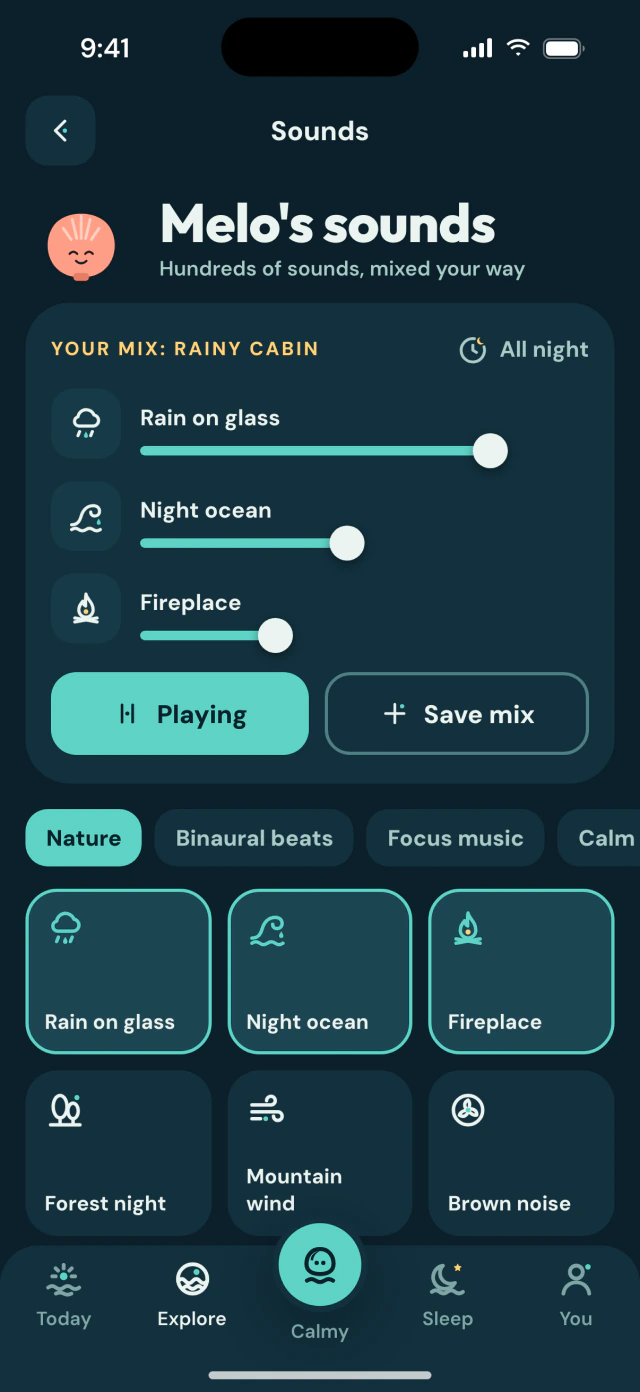
Many people sleep best with two or three layers: a broad bed (rain or brown noise) for masking, a texture (a crackling fire, a page turning) for comfort, and sometimes a soft musical pad. In CalmDepth, Melo builds a mix with you: pick up to eight layers (three on the free tier), set each one's level, save the mix and set it to play all night. The mix in the screenshot, "Rainy Cabin", layers rain on glass, a distant night ocean and a fireplace.
Inside CalmDepth's sound library
We built 2,055 sounds in 13 families, each a seamless loop with its own painting so you can find it again at a glance. Most loops run two to three minutes before they repeat invisibly; binaural beats run five.
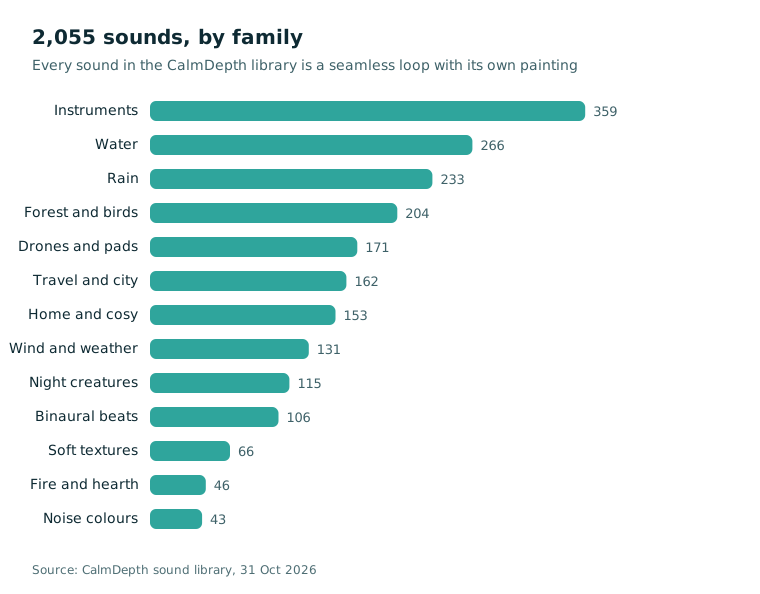
| Family | Sounds | A few examples |
|---|---|---|
| Instruments | 359 | Low Bronze Bowls, Crystal Bowls, Evening Bowls |
| Water | 266 | Babbling Stream, Ocean Waves, Pebble Shore, Waterfall Hush |
| Rain | 233 | Light Rain, Rain on the Roof, Rain on the Tent, Rain on the Car |
| Forest and birds | 204 | Dawn Chorus, Woodland Birdsong, Hedgerow Morning |
| Drones and pads | 171 | Amber Pad in C, Moss Pad in A |
| Travel and city | 162 | Train Ride, Rail Carriage Hum, Cafe Murmur |
| Home and cosy | 153 | Table Fan, Air Conditioner, Tumble Dryer, Quiet Clock |
| Wind and weather | 131 | Gentle Breeze, Wind over Grass, Distant Thunder |
| Night creatures | 115 | Cricket Field, Cicadas at Dusk, Spring Peepers |
| Binaural beats | 106 | Deep Rest 1 Hz with Brown Noise, Deep Rest 2 Hz with Ocean |
| Soft textures | 66 | Slow Brushing, Pencil on Paper, Turning Pages, Knitting |
| Fire and hearth | 46 | Campfire, Wood Stove, Candle Flutter |
| Noise colours | 43 | White, Pink, Brown, Blue, Violet, Grey and Green Noise |
| Total | 2,055 |
Our sounds are made in house by synthesis and from public domain or CC0 field recordings (for example Wikimedia Commons and the US National Park Service), each with its licence checked and recorded.
Sounds live alongside the rest of your night in CalmDepth: Bedtime with Sleepy, 15 Sleep Music pieces of about 46 minutes, Back to sleep for the small hours and a morning report from Apple Health or Health Connect. If you prefer a voice to a sound, read our guide to sleep stories for adults.
CalmDepth is arriving soon on iPhone and Android; the waitlist is open on our home page.
A simple one week sound experiment
| Night | What to try | What to notice |
|---|---|---|
| 1 and 2 | Steady rain, soft, all night | How quickly you settle |
| 3 and 4 | Brown noise, soft, all night | Whether night noises still wake you |
| 5 and 6 | Your favourite of the two plus one comfort layer (fire, pages) | Whether it feels cosier |
| 7 | Silence | How the night compares |
Write one line each morning: how rested do you feel, from one to five? After a week you will know more than any review can tell you.
Building your first sleep mix, step by step
- Pick a bed. One broad, steady sound: Steady Rain, Brown Noise or Slow River.
- Add one comfort layer. A fire, a quiet clock, turning pages. Keep it quieter than the bed.
- Optional: a soft pad. A drone such as "Amber Pad in C" adds warmth without melody.
- Balance. The bed carries the masking; the other layers are seasoning.
- Name and save it. "Rainy Cabin", "Summer Window", whatever makes you smile.
- Set all night or a fade. Then put the phone face down across the room.
Sounds for special situations
| Situation | Try |
|---|---|
| Travelling, a new hotel room | The same mix you use at home: familiarity is the point |
| Shift work, sleeping by day | Brown noise or a fan hum, plus blackout curtains or an eye mask |
| A new baby in the house (for the parents) | Soft rain at a low level, so you still hear the baby |
| Napping | A 20 minute timer with a slow fade |
| Waking at 3 a.m. | Keep the night's sound playing; see how to fall back asleep |
| Curious about brain wave sounds | Slow binaural beats with headphones; see binaural beats for sleep |
FAQ
What is the best sound for sleep?
There is no single best sound. For noisy rooms, broad steady sounds such as brown noise, pink noise or heavy rain mask interruptions best. For a busy mind, gentle rain, a slow river or a soft pad gives attention somewhere calm to rest.
Is it okay to sleep with sounds on all night?
For most adults, yes, at a soft level. Keep the volume low enough to talk over easily and place the speaker away from your head. If you prefer silence later in the night, use a timer with a slow fade.
Do sleep sounds really work?
Many people find them comforting, and they help mask noise. A 2021 systematic review found the scientific evidence for continuous noise as a sleep aid to be of very low quality so far, so the best test is your own week long trial.
Are rain sounds or white noise better?
Rain is a natural broadband sound with gentle texture; white noise is flat and brighter. Many people find rain or the deeper pink and brown noises more pleasant than pure white noise.
Can I mix several sounds?
Yes. In CalmDepth you can mix up to eight layers with premium or three on the free tier, set each level, save the mix and play it all night.
Do sleep sounds work for babies?
Some parents use soft sounds for babies. Keep the level very low and the device well away from the cot, and follow your health visitor's or paediatrician's advice.
Sources
Keep reading
 White, Pink or Brown Noise: Which Is Best for Sleep?White, pink and brown noise explained with a clear chart, what the research says about each for sleep, and how to pick the right one for your bedroom.
 Binaural Beats for Sleep: How They Work and What to ExpectWhat binaural beats are, why they need headphones, what research shows for relaxation and sleep, and how to try them safely tonight.
 Sleep Stories for Adults: Why They Work and How to Choose OneWhat makes a sleep story actually help you drift off, from pacing to plot, plus 21 unhurried worlds with Sleepy you can try tonight.
 How to Fall Back Asleep in the Middle of the NightA gentle, step by step plan for 3 a.m. wake ups: what to do in the first minute, which breath to use, when to get up, and when to talk to a doctor.