





Binaural Beats for Sleep: How They Work and What to Expect
What binaural beats are, why they need headphones, what research shows for relaxation and sleep, and how to try them safely tonight.
Put on headphones. In your left ear, a steady tone at 100 hertz. In your right, one at 102. Neither ear hears anything but a plain hum, yet you perceive a slow, soft pulse twice a second, somewhere in the middle of your head. That pulse is a binaural beat. It does not exist in the air; your brain creates it by comparing the two tones.
Binaural beats have attracted big claims: deep sleep on demand, brainwaves "tuned" in minutes. The evidence tells a more modest and more interesting story. Below: how they work, what the research supports, and how to try them for sleep.
How binaural beats work
- Each ear receives a slightly different pure tone, called the carrier (for example 100 Hz and 102 Hz).
- The brainstem compares the two signals and perceives the difference, here 2 Hz, as a gentle beat.
- The beat frequency is chosen to match a brainwave band: slow beats for rest, faster beats for focus.
Headphones are essential. If both tones play from a speaker, they mix in the air and you hear an ordinary acoustic beat instead. Comfortable, flat headphones or a sleep headband work best for bed.
The brainwave bands behind the names
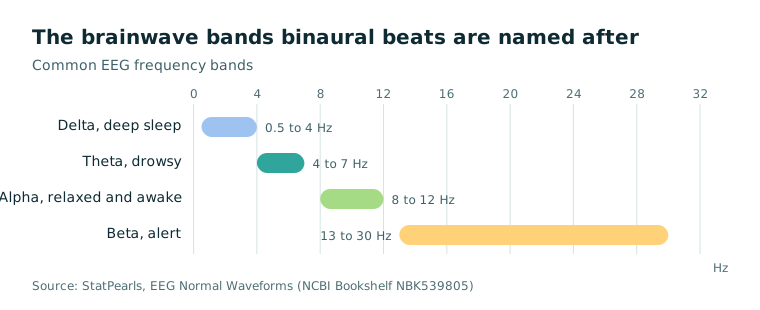
| Band | Frequency | Typical state |
|---|---|---|
| Delta | 0.5 to 4 Hz | Deep sleep |
| Theta | 4 to 7 Hz | Drowsiness, light sleep |
| Alpha | 8 to 12 Hz | Relaxed and awake, often with eyes closed |
| Beta | 13 to 30 Hz | Alert, focused, active thinking |
Ranges from StatPearls (NCBI Bookshelf). Other sources draw the borders slightly differently.
The idea behind binaural beats for sleep is "entrainment": that hearing a 2 Hz beat might nudge the brain towards the slow rhythms of deep sleep. The evidence for direct entrainment is mixed. A more grounded way to think about it: a slow, steady, soft pulse is a relaxing sound, and relaxation helps sleep.
What the research shows
- Anxiety and attention. The most cited meta analysis, by Garcia-Argibay and colleagues in Psychological Research (2019), pooled 22 studies with 35 effect sizes on memory, attention, anxiety and pain. It found an overall medium effect (g = 0.45). Exposure before a task worked better than exposure only during it, longer exposure helped, and masking the beats with white or pink noise was not needed for the effect.
- Sleep specifically. Sleep studies of binaural beats are small, and results are inconsistent. No large, high quality trial has shown that binaural beats reliably deepen sleep.
- Sound for sleep in general. A 2021 systematic review of continuous noise as a sleep aid rated the evidence as very low quality, a reminder that many popular sleep sounds are still waiting for strong research.
Bottom line: binaural beats may help some people relax, and relaxing helps some people sleep. Try them with curiosity, not expectations.
How to try binaural beats for sleep
- Headphones on, volume low. Just audible. The WHO and ITU safe listening standard uses 80 dB for 40 hours a week as an adult reference; a bedtime sound should sit far below it.
- Choose a slow beat. Delta (1 to 4 Hz) or theta (4 to 7 Hz) for winding down.
- Start before sleep. Research suggests exposure before the task works better, so begin 15 to 30 minutes before you want to sleep, while reading or breathing.
- Pair with a calm breath. A few rounds of 4-7-8 breathing or a longer exhale helps the body follow.
- Use a soft bed of sound. Many people find pure tones odd; beats carried on brown noise or ocean sound feel more natural.
- Give it a week. Notice how quickly you settle and how rested you feel.
Who should take care
- People with epilepsy or a history of seizures should check with their doctor before using rhythmic audio stimulation.
- Do not use binaural beats while driving or doing anything that needs full attention.
- Remove headphones if they are uncomfortable to sleep in; ear pain is a reason to stop.
- Children: keep any sound at a very low level, and prefer a speaker over headphones.
Binaural beats in CalmDepth
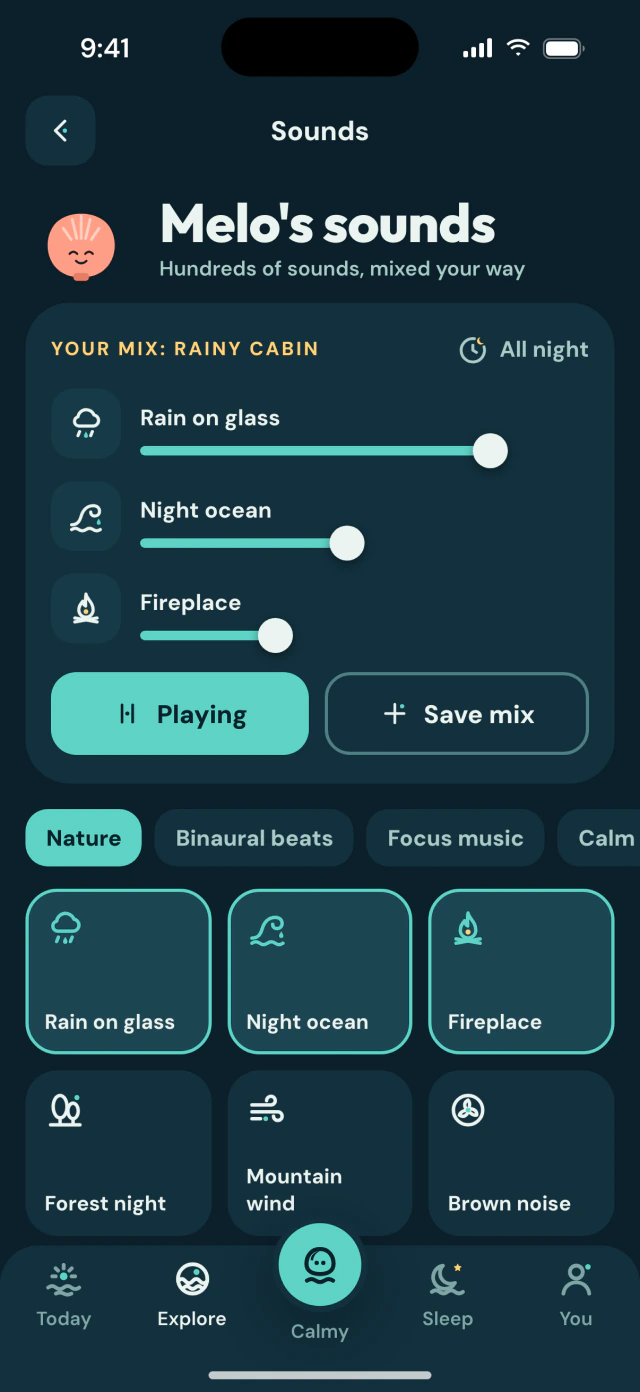
Melo's library includes 106 binaural beats in four groups, each with its beat and carrier stated, so you always know what you are hearing:
| Group | Beat frequency | Band | Use |
|---|---|---|---|
| Deep Rest | 1 to 4 Hz | Delta | Drifting off |
| Drift | 4 to 7 Hz | Theta | Winding down, rest |
| Ease | 8 to 12 Hz | Alpha | Relaxed, awake calm |
| Focus | 14 to 18 Hz | Beta | Steady focus by day |
Each beat sits under a soft bed of brown noise, pink noise, ocean sound or pure tones, and runs as a seamless five minute loop that can play all night. For example, "Deep Rest 1 Hz, Brown Noise 100" is a 1 Hz beat on a 100 Hz carrier under a soft brown noise bed. You can layer any binaural beat with rain, a fire or Sleep Music in Melo's mixer.
If headphones are not for you, try a noise colour instead: see white, pink and brown noise and our sleep sounds guide.
CalmDepth is arriving soon on iPhone and Android; the waitlist is open on our home page.
Binaural beats, isochronic tones and noise compared
| Binaural beats | Isochronic tones | Noise colours | |
|---|---|---|---|
| What you hear | A soft pulse created inside your head from two tones | A single tone switching on and off | Broad, steady sound |
| Headphones needed | Yes | No | No |
| Main use | Relaxation, focus | Focus, relaxation | Masking noise, comfort |
| Research base | Small to medium studies, mixed | Very limited | Small, mixed for sleep |
| Best for bed | Slow beats on a soft bed, low volume | Can feel too insistent | Brown or pink noise, soft |
Myths and facts
| You may read | What is known |
|---|---|
| "Binaural beats put you into deep sleep in minutes." | No study shows this reliably. They may help some people relax. |
| "You can hear them through any speaker." | You need headphones, one tone per ear. |
| "Higher volume works better." | Volume does not create the beat; keep it soft. |
| "They are a replacement for sleep medicine." | They are a relaxation tool. Talk to a doctor about ongoing sleep problems. |
| "They must be hidden under white noise to work." | The 2019 meta analysis found masking with noise was not necessary. |
Building a gentle binaural mix
- Start with a slow beat from the Deep Rest or Drift group.
- Add one natural layer: soft rain, a distant ocean or a quiet fire.
- Keep the binaural layer a little under the natural one.
- Set the mix to play all night, or use a timer with a slow fade.
- If you wake in the night, leave it playing and try the steps in our guide to falling back asleep.
FAQ
Do binaural beats help you sleep?
They may help some people relax, which can make falling asleep easier. Research on sleep specifically is small and mixed, so treat them as a relaxation tool, not a guaranteed sleep aid.
Which binaural beat frequency is best for sleep?
Slow beats in the delta range (about 1 to 4 Hz) and theta range (4 to 7 Hz) are the usual choices for sleep and winding down. There is no proven single best frequency.
Do I need headphones for binaural beats?
Yes. Each ear must hear a different tone. Through speakers, the tones mix in the air and the binaural effect disappears.
Is it safe to sleep with binaural beats?
For most adults at a low volume, yes. Stop if headphones hurt, keep the level low, and check with a doctor first if you have epilepsy.
How long should I listen to binaural beats?
Start 15 to 30 minutes before you want to sleep. Research found longer exposure and listening before the task gave stronger effects.
Are binaural beats the same as white noise?
No. White noise is a broad, random sound that masks other noises. Binaural beats are two pure tones that create a perceived pulse, and they need headphones.
Sources
- Garcia-Argibay M, Santed MA, Reales JM. Efficacy of binaural auditory beats in cognition, anxiety, and pain perception: a meta-analysis. Psychol Res 2019;83(2):357
- StatPearls: EEG Normal Waveforms (NCBI Bookshelf NBK539805)
- Riedy SM et al. Noise as a sleep aid: a systematic review. Sleep Med Rev 2021
- WHO and ITU: Safe listening devices and systems (H.870)
- CalmDepth binaural beats
Keep reading
 White, Pink or Brown Noise: Which Is Best for Sleep?White, pink and brown noise explained with a clear chart, what the research says about each for sleep, and how to pick the right one for your bedroom.
 Sleep Sounds: How to Choose Rain, Ocean or Noise for Better NightsHow sleep sounds work, which ones suit which bedroom, safe volume and timer tips, and a library of 2,055 seamless sounds you can mix your way.
 How to Fall Back Asleep in the Middle of the NightA gentle, step by step plan for 3 a.m. wake ups: what to do in the first minute, which breath to use, when to get up, and when to talk to a doctor.
 4-7-8 Breathing: How to Do It, What It Helps and What the Science SaysLearn the 4-7-8 breath step by step, how it compares with box and calm breathing, what research supports, and how to use it at bedtime.