





White, Pink or Brown Noise: Which Is Best for Sleep?
White, pink and brown noise explained with a clear chart, what the research says about each for sleep, and how to pick the right one for your bedroom.

Noise colours sound like marketing, but they describe something precise: how a sound's energy is spread from low pitches to high ones. White noise spreads it evenly per hertz and sounds bright, like a detuned radio. Pink noise tilts towards the low end and sounds like steady rain. Brown noise tilts further still and sounds like a deep waterfall or the rumble inside a plane.
Which one helps you sleep depends far more on your ears and your bedroom than on any ranking. Here is how they differ, what the research shows, and a quick way to choose.
The three colours in one chart
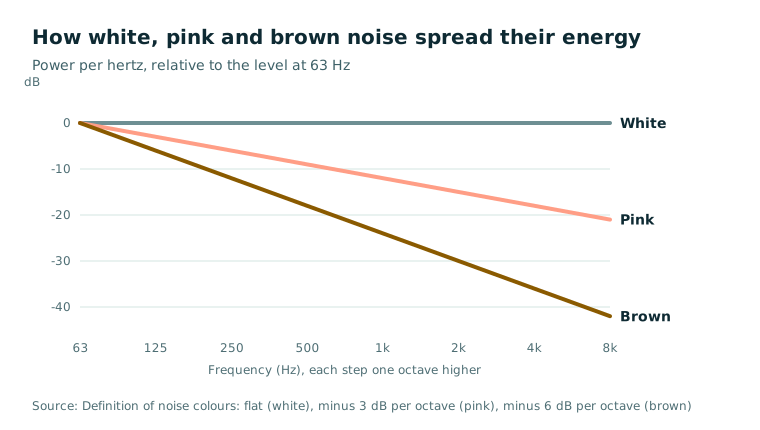
| Frequency | White (dB) | Pink (dB) | Brown (dB) |
|---|---|---|---|
| 63 Hz | 0 | 0 | 0 |
| 125 Hz | 0 | minus 3 | minus 6 |
| 250 Hz | 0 | minus 6 | minus 12 |
| 500 Hz | 0 | minus 9 | minus 18 |
| 1 kHz | 0 | minus 12 | minus 24 |
| 2 kHz | 0 | minus 15 | minus 30 |
| 4 kHz | 0 | minus 18 | minus 36 |
| 8 kHz | 0 | minus 21 | minus 42 |
Power per hertz relative to 63 Hz. These slopes are the definitions of the colours: white is flat, pink falls by 3 dB for every doubling of frequency, brown by 6 dB.
Because our ears hear in octaves, flat white noise ends up with as much energy in the single top octave (8 to 16 kHz) as in all the octaves below it combined. That is why it sounds hissy. Pink noise gives every octave the same energy, which many people hear as balanced. Brown noise leans so far towards the bass that the top end almost disappears.
How each one sounds and who it suits
| Colour | Sounds like | Masks best | Often chosen by |
|---|---|---|---|
| White | Radio static, a hissing kettle | High pitched noise: voices, birds, a ringing tinnitus like whine | People in loud cities, shift workers sleeping by day |
| Pink | Steady rain, wind through trees | A broad mix of household and street sounds | People who find white noise too sharp |
| Brown | A deep waterfall, a plane cabin, distant surf | Low rumbles: traffic, snoring, a neighbour's bass | People who like a deep, enveloping sound |
| Grey | Tuned to sound equally loud at every pitch | Mixed noise | Listeners sensitive to particular pitches |
| Green | The middle of the range, like a calm forest | Gentle masking | People who want something more natural |
Blue and violet noise tilt the other way, towards the treble; they are rarely used for sleep but some people like them for focus.
What the research says
The science is thinner than the enthusiasm.
- Continuous noise in general. A 2021 systematic review of 38 studies in Sleep Medicine Reviews rated the evidence that continuous noise improves sleep as very low quality. Some studies found people fell asleep faster; others found more disrupted sleep. The authors recommend better research before noise is promoted as a sleep aid.
- Pink noise in the lab. Several studies have used short bursts of pink noise, timed by computer to the brain's slow waves during deep sleep. A small 2017 study of 13 adults aged 60 to 84 (Papalambros and colleagues, Frontiers in Human Neuroscience) found that pink noise pulses timed to slow waves strengthened slow wave activity during stimulation and improved overnight word recall compared with a sham night. That is not the same as playing pink noise all night from a phone, and it is often misquoted as if it were.
- Brown noise. Its popularity has run well ahead of the research. People love it for its depth and comfort, which is a perfectly good reason to use it, as long as we do not pretend it has been proven to do more.
The practical takeaway: noise colours are tools for comfort and masking. Pick the one that makes your room feel quietest and that you enjoy hearing.
A quick way to choose
- Listen to the problem. Lie in bed with the lights off and notice what actually bothers you. High voices and birds? Low traffic and snoring? Silence that leaves your thoughts too loud?
- Match the colour. High sounds: white or pink. Low sounds: brown. A busy mind: pink, brown or rain.
- Set it soft. Just loud enough to blur the problem, quiet enough to talk over. The WHO and ITU safe listening standard sets 80 dB for 40 hours a week as an adult reference; a sleep sound should sit far below it.
- Give it three nights. The first night with any new sound feels unusual. Judge on the third.
- Keep it running or fade slowly. If you wake when it stops, let it play all night.
Mixing colours with nature
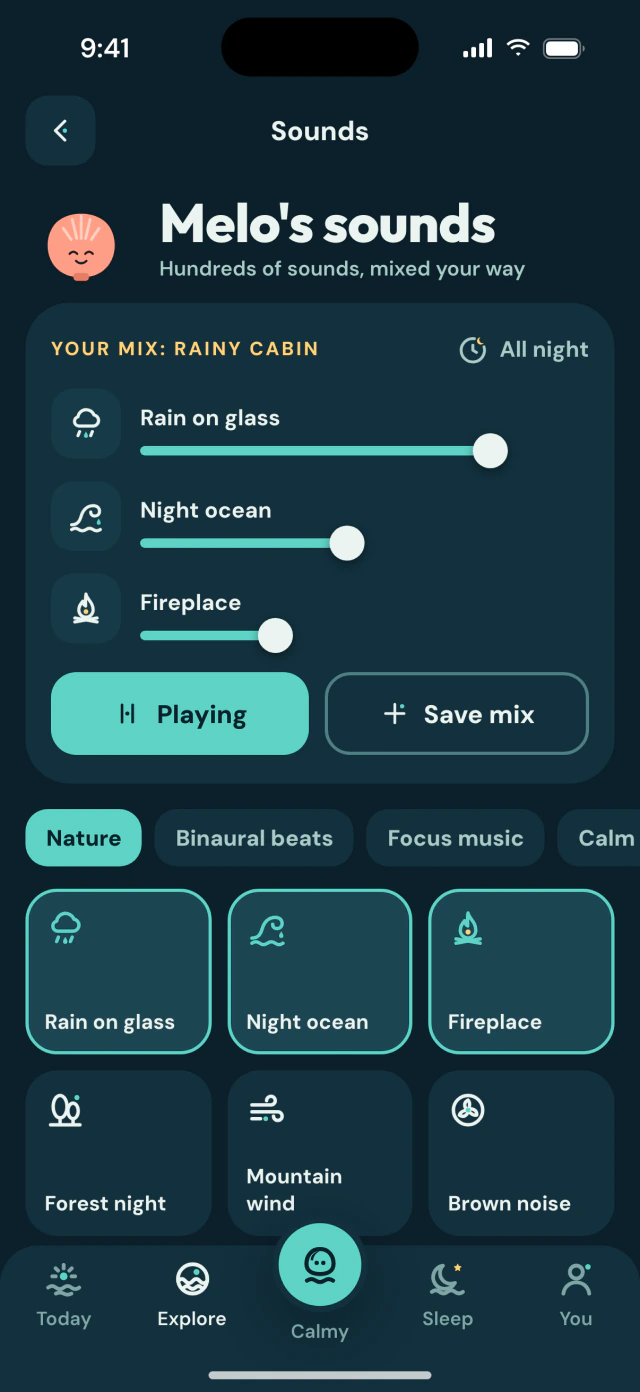
Pure noise can feel clinical. Many people prefer a noise bed under something natural: brown noise under rain on a tent, pink noise under a crackling fire. In CalmDepth, Melo's library has 43 noise colours, from White, Pink and Brown to softer variations such as Warm Pink, Deep Brown and Velvet Hush, and you can layer them with any of our other 2,012 sounds (up to eight layers with premium, three free).
The library also has 106 binaural beats, several of which are carried on brown noise or ocean sound. If you are curious about those, read binaural beats for sleep. For the broader picture of sounds for sleep, see our sleep sounds guide.
CalmDepth is arriving soon on iPhone and Android; the waitlist is open on our home page.
Noise for focus, naps and babies
| Use | Colour often chosen | Tip |
|---|---|---|
| Focus at a desk | Brown or pink | Low level, so it fades into the background after a few minutes |
| Open plan office | Pink | Masks speech without the hiss of white noise |
| A short nap | Brown | Use a 20 minute timer with a fade |
| Babies (for the room) | Soft pink or brown | Very low, well away from the cot |
| Waking at night | The colour you fell asleep to | Familiarity helps; see how to fall back asleep |
Myths about noise colours
| You may read | What is known |
|---|---|
| "Brown noise is scientifically proven to be best for sleep." | Research on brown noise for sleep is limited; preference is a good guide |
| "Pink noise boosts memory." | Only in lab studies with precisely timed pulses, not continuous playback |
| "Louder masks better." | A soft level masks most sounds and is kinder to your ears |
| "White noise is only for babies." | Adults use it widely, especially in noisy cities |
FAQ
Is brown noise better than white noise for sleep?
Neither is proven better. Brown noise is deeper and masks low rumbles such as traffic and snoring; white noise is brighter and masks high sounds. Many people find brown or pink noise more pleasant to sleep with.
What is pink noise good for?
Pink noise has equal energy in every octave, so it sounds balanced, like steady rain. It is a good all round choice for masking household and street noise.
Why does white noise sound so harsh?
White noise has equal energy per hertz, which puts as much energy in the highest octave as in all lower octaves combined. Our ears hear that as hiss.
Can I sleep with brown noise all night?
Yes, for most adults at a soft level, with the speaker away from your head. Turn it down if you notice ringing ears or a muffled feeling in the morning.
Is green noise a real thing?
It is a popular name for noise centred in the middle of the audible range, often described as sounding like nature. It is not a strict technical standard like white, pink and brown noise.
Does pink noise improve memory?
Lab studies that played short pink noise bursts precisely timed to deep sleep brain waves have found links to better memory in small groups of people. Playing pink noise continuously from a phone has not been shown to do the same.
Sources
- Riedy SM et al. Noise as a sleep aid: a systematic review. Sleep Med Rev 2021;55:101385
- Papalambros NA et al. Acoustic enhancement of sleep slow oscillations and concomitant memory improvement in older adults. Front Hum Neurosci 2017
- WHO and ITU: Safe listening devices and systems (H.870)
- CalmDepth sound library
Keep reading
 Sleep Sounds: How to Choose Rain, Ocean or Noise for Better NightsHow sleep sounds work, which ones suit which bedroom, safe volume and timer tips, and a library of 2,055 seamless sounds you can mix your way.
 Binaural Beats for Sleep: How They Work and What to ExpectWhat binaural beats are, why they need headphones, what research shows for relaxation and sleep, and how to try them safely tonight.
 How to Fall Back Asleep in the Middle of the NightA gentle, step by step plan for 3 a.m. wake ups: what to do in the first minute, which breath to use, when to get up, and when to talk to a doctor.