


Meditation for Anxiety: What Helps, What the Research Shows
Which meditation practices help anxious minds, what large reviews actually found, how to start gently and when to reach out for more support.
If you live with anxiety, someone has probably told you to "just meditate", as if a racing mind could be switched off by sitting still. The first time you try, the opposite often happens: in the quiet, the worries get louder. That is not a sign that meditation is wrong for you. It is a sign that the instructions were.
Meditation helps anxious minds not by emptying them, but by changing your relationship with what is in them: noticing a worry as a worry, letting the body settle first, and coming back to something steady. This guide explains which practices suit anxiety, what the research shows, and how to begin in a way that feels safe.
What the research shows
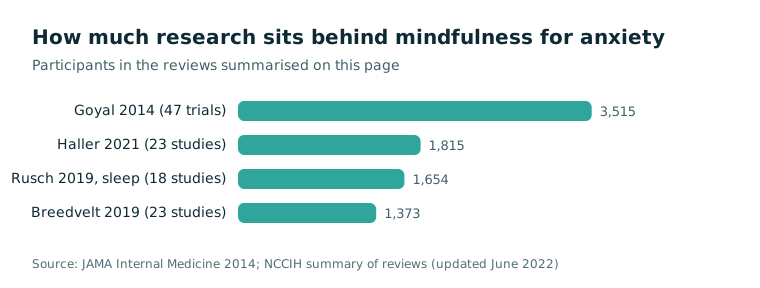
| Review | Studies | Participants | Main finding |
|---|---|---|---|
| Goyal and colleagues, JAMA Internal Medicine 2014 | 47 randomised trials | 3,515 | Moderate evidence that mindfulness meditation programs improve anxiety, depression and pain |
| 2021 analysis of adults with diagnosed anxiety disorders (summarised by NCCIH) | 23 | 1,815 | Mindfulness generally did better than usual care in the short term; some studies matched CBT; few looked beyond two months |
| 2019 analysis in university students (summarised by NCCIH) | 23 | 1,373 | Yoga, mindfulness and meditation had some effect on stress, anxiety and depression; many studies were of low quality |
| 2019 analysis on sleep (summarised by NCCIH) | 18 | 1,654 | Mindfulness meditation improved sleep quality more than education based approaches |
In short: regular meditation, especially mindfulness, produces real but modest benefits for anxiety. It works best as a daily practice over weeks, alongside, not instead of, professional care when anxiety is severe. NCCIH notes that meditation is generally considered low risk, but that some people have unpleasant experiences, most commonly anxiety itself, which is why the right style matters.
Five practices that suit anxious minds
1. Body first, then mind
When anxiety is high, sitting still with thoughts can feel like being locked in with them. Start with the body: shake out your hands, roll your shoulders, tense and release your fists, then sit. Several CalmDepth singles, such as "Settling a Busy Brain", begin with movement for exactly this reason.
2. Eyes open grounding
Closing your eyes can feel unsafe when anxious. Keep them open, feel your feet on the floor and your weight in the chair, and name a few things you can see and hear. CalmDepth's "Steady Ground" is a ten minute eyes open anchoring practice. Every CalmDepth meditation offers the choice of eyes open or closed, spoken aloud.
3. Breath with a longer exhale
Rest attention on the breath and let the out breath grow slightly longer than the in breath. If counting helps: in for four, out for six. Our guide to breathing exercises for anxiety covers five breaths and when to use each.
4. Noting
When a worry appears, give it a soft one word label, "planning", "what if", "remembering", and return to your anchor. Labelling a thought puts a small space between you and it. Over time, you begin to see worries as events in the mind rather than facts about the world. One of the days in our Calm Stress and Anxiety journey is titled exactly that: "Thoughts Are Guesses, Not Facts".
5. Kindness
Anxiety is often accompanied by a harsh inner voice. A few minutes of kindness practice, quietly wishing yourself and others well, softens it. It can feel awkward at first; it gets easier.
Which practice for which kind of anxiety
| Experience | Start with | Length |
|---|---|---|
| General worry that hums all day | Noting plus breath | 10 min daily |
| Racing heart and tight chest | Body first, then longer exhales | 5 min |
| Rising panic | Eyes open grounding; see breathing guide | 3 to 5 min |
| Anxiety at night | Body scan, then a sleep story or sound; see overthinking at night | 10 to 15 min |
| Nerves before a big moment | Grounding through the feet, one steadying breath pattern | 2 to 5 min |
| Health worry | Noticing the worry in body and mind, then gently widening attention | 10 min |
How to start without making it worse
- Short and often. Five minutes a day beats forty five on a Sunday. Our meditation for beginners guide has a seven day plan.
- Guided first. A calm voice gives your attention somewhere to go.
- Keep your eyes open if you like. It is not cheating.
- Stop when you need to. If a practice brings up strong distress, open your eyes, feel your feet, breathe out slowly, and try a shorter or more active practice next time.
- Measure by returning, not by feeling calm. Some sessions will feel restless. You still trained the skill.
Meditation for anxiety in CalmDepth
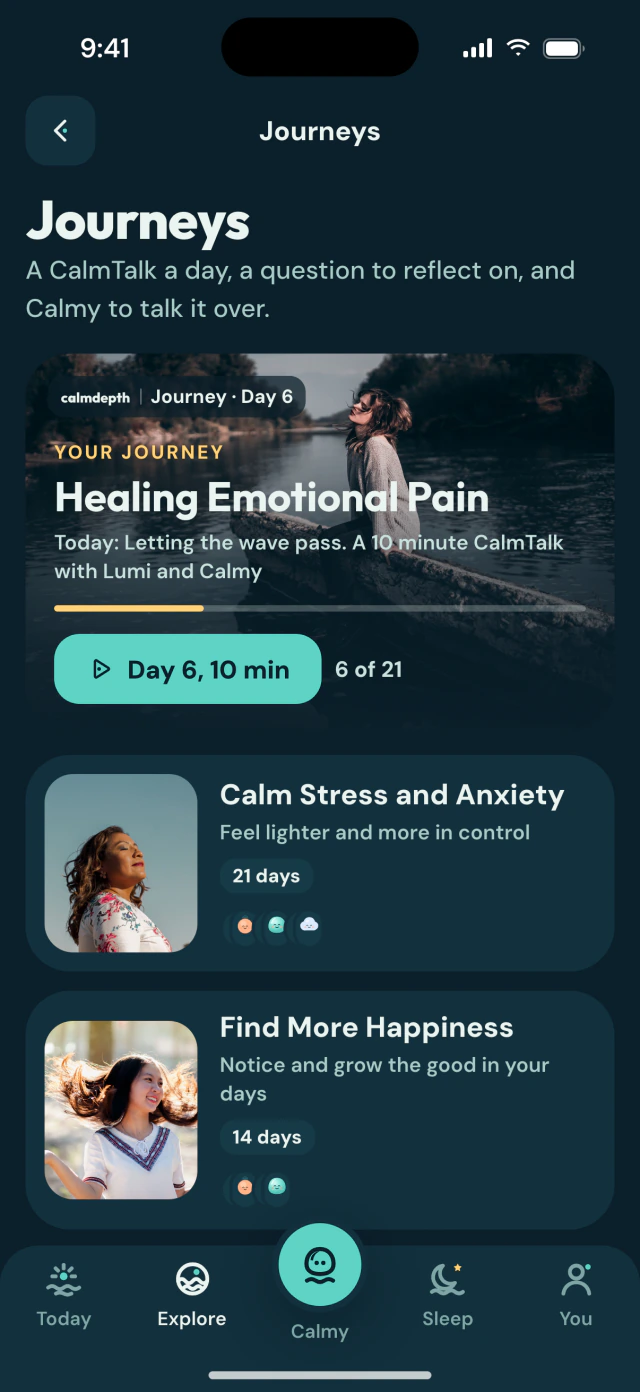
CalmDepth is built so that the right practice is close at hand in the moment you need it:
- Calm Stress and Anxiety, a 21 day journey with Lumi, Calmy and Breezy. Each day: a ten minute CalmTalk, a reflection question and Calmy to talk it through. Early days include "Your Alarm Means Well", "Stress and Anxiety Are Different", "Your Breath Is a Dial", "Give Worry Its Own Window" and "Living With Not Knowing".
- Meditate singles for named needs: "Riding the Wave" and "When Your Heart Races" (five minutes each, for rising panic), "After the Wave" (for after a panic attack), "Steady Ground", "When You Worry About Your Health", "Unclench" and more.
- Calm Now, always free: short sessions for the moment it all feels like a lot, one tap from any screen.
- Calmy, the AI friend who listens. Calmy asks one good question, offers a breath with Breezy when it helps, and remembers only what you choose. In hard moments Calmy stays with you and shows the support line for your country.
CalmDepth is arriving soon on iPhone and Android; the waitlist is open on our home page.
When to get more support
Meditation is a good daily companion; it is not a treatment for an anxiety disorder. The NHS describes generalised anxiety disorder as "a common mental health condition where you often feel very anxious about lots of different things", and suggests seeing a GP if you think you might have it. In England, adults can also refer themselves to NHS talking therapies. Effective treatments exist.
If you are in crisis or thinking about ending your life, please reach out now. In the US, call or text 988 (24/7) or text HOME to 741741. In the UK and Ireland, call Samaritans on 116 123 (24/7), or in the UK text SHOUT to 85258. In an emergency, call 911, 999 or 112.
A 14 day starter plan
| Days | Practice | Length |
|---|---|---|
| 1 to 3 | Body first: shake out, then ten calm breaths with a longer exhale | 5 min |
| 4 to 6 | Eyes open grounding: feet, seat, five things you can see | 5 to 10 min |
| 7 to 9 | Breath with noting: label thoughts "planning", "worrying", return | 10 min |
| 10 to 11 | Body scan, feet to head | 10 min |
| 12 | Kindness: wish yourself and one person well | 5 to 10 min |
| 13 to 14 | Your favourite practice, plus a two minute breath before a hard moment | 10 min |
Keep a one line note each day: how anxious did you feel before and after, from one to ten? After two weeks the pattern usually tells you which practices to keep.
Breath and meditation together
Breathing is the quickest way in when anxiety is high; meditation is how you stay. Many people start a session with a minute of slow breathing, such as the calm breath or a few rounds of the 4-7-8 breath, and then move to noticing. If you only have two minutes, the breath alone is enough.
FAQ
Does meditation really help anxiety?
Yes, for many people. A 2014 review of 47 randomised trials found moderate evidence that mindfulness meditation programs improve anxiety. Benefits build with regular practice over weeks.
What type of meditation is best for anxiety?
Mindfulness, started with the body and the breath, has the strongest evidence. Eyes open grounding and kindness practices also suit anxious minds.
Why does meditation sometimes make my anxiety worse?
Sitting in silence can make worries more noticeable at first. Start with movement, keep your eyes open, use a guided session and keep it short. Stop if distress feels too strong and try a more active practice.
How long does it take for meditation to help anxiety?
Studies usually run for around eight weeks of regular practice. Many people notice small changes, like recovering faster after a worry, within the first few weeks.
Can I meditate during a panic attack?
A full meditation is hard in the moment. Grounding with eyes open and slow out breaths helps more. Meditation practised on calmer days makes those tools easier to reach.
Should I use meditation instead of seeing a doctor?
No. If anxiety is affecting your life, talk to a doctor. Meditation works well alongside professional support.
Sources
- Goyal M et al. Meditation programs for psychological stress and well-being: a systematic review and meta-analysis. JAMA Intern Med 2014;174(3):357
- NCCIH: Meditation and Mindfulness, Effectiveness and Safety (updated June 2022)
- NHS: Generalised anxiety disorder in adults
- 988 Suicide and Crisis Lifeline
- Samaritans
Keep reading
 Breathing Exercises for Anxiety: Five That Work and When to Use EachFive breathing exercises for anxious moments, from the NHS calm breath to box breathing, with what research shows and a guide to picking the right one.
 How to Stop Overthinking at Night and Let Your Mind RestWhy thoughts get loud at bedtime and seven calm ways to quiet them, from a five minute to do list to a longer exhale, backed by research.
 Meditation for Beginners: A Gentle Seven Day StartHow to start meditating in five minutes a day: posture, breath, what to do with a busy mind, and a simple seven day plan you can follow tonight.
 4-7-8 Breathing: How to Do It, What It Helps and What the Science SaysLearn the 4-7-8 breath step by step, how it compares with box and calm breathing, what research supports, and how to use it at bedtime.