

Breathing Exercises for Anxiety: Five That Work and When to Use Each
Five breathing exercises for anxious moments, from the NHS calm breath to box breathing, with what research shows and a guide to picking the right one.
Anxiety lives in the body before it reaches words. The chest tightens, breathing gets quick and high, the shoulders climb. Breathing is the one part of that response you can steer directly, any time, without anyone noticing. That is why every good anxiety toolkit starts here.
Not every breath suits every moment, though. A strict count that calms you at bedtime can feel suffocating in a panic. Below are five exercises, when each one fits, and what the research behind them shows. They are the same practices Breezy guides in CalmDepth's Breathe and Calm Now.
Why slow breathing calms
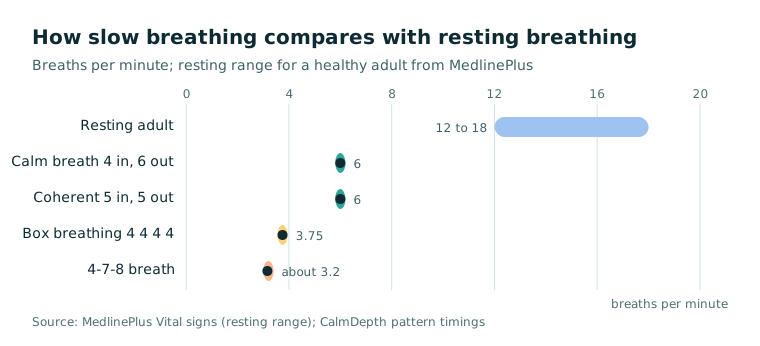
When you breathe more slowly, and especially when you let the out breath be longer than the in breath, heart rate tends to ease with it. A 2018 systematic review of 15 studies in Frontiers in Human Neuroscience found slow breathing (fewer than ten breaths a minute) linked with more comfort and relaxation and less anxiety, along with higher heart rate variability, a sign of a calmer nervous system. A 2023 randomised study in Cell Reports Medicine compared five minutes a day of breathing practices with mindfulness meditation for a month; the exhale focused practice, cyclic sighing, improved mood and lowered breathing rate the most.
| Pattern | Breaths per minute |
|---|---|
| Resting adult (MedlinePlus) | 12 to 18 |
| Calm breath, 4 in 6 out | 6 |
| Coherent breathing, 5 in 5 out | 6 |
| Box breathing, 4 4 4 4 | 3.75 |
| 4-7-8 breath | about 3.2 |
The five exercises
1. The NHS calm breath (for everyday stress)
The NHS recommends this one, and it needs nothing but five minutes.
- Get comfortable: standing, sitting with your back supported, or lying down.
- Let your breath drop into your belly without forcing it, ideally in through the nose and out through the mouth.
- Breathe in gently, counting from one to five. You may not reach five at first.
- Breathe out gently, counting from one to five.
- Continue for at least five minutes.
The NHS notes you get the most benefit if you practise regularly, not only when stressed.
2. The calm breath, in for 4, out for 6 (for any anxious moment)
The simplest way to tip your breath towards calm: make the exhale longer than the inhale. In through the nose for four, out through soft lips for six. No holds, so it never feels like you are running out of air. You can do it with eyes open at a desk, on a train, in a queue. In CalmDepth, "Calm Breath, Eyes Open" is two minutes of exactly this.
3. The physiological sigh (for a sudden spike)
This is the body's own reset button; you already do it after crying. Breathe in through the nose, then take a second short sip of air on top, and let it all out slowly through the mouth. One to three sighs often take the edge off quickly. Cyclic sighing, repeating this pattern for five minutes, was the practice that improved mood most in the 2023 Cell Reports Medicine study.
4. Box breathing (before a big moment)
In for four, hold for four, out for four, hold for four. The equal sides give the mind a clear job and steady you before a presentation, an exam or a difficult call. If the holds feel uncomfortable, shorten them. CalmDepth's "Before You Walk In" is a two minute Calm Now session built on a light version of this.
5. Grounding breath (for panic)
In a panic attack, counting can feel impossible. Ground first, then breathe:
- Keep your eyes open. Press your feet into the floor and feel it push back.
- Name, out loud or silently, five things you can see.
- Put a hand on your chest and one on your belly.
- Breathe out slowly, as if through a straw. Let the in breath come by itself.
- Repeat the long out breath until the wave starts to pass.
Panic peaks and passes. Reminding yourself of that is part of the exercise. CalmDepth's "When It Surges" is a three minute Calm Now session for a wave of panic: eyes open grounding, feet and hands, and long exhales.
Which exercise when
| Moment | Try | Length |
|---|---|---|
| Rising stress during the day | Calm breath, 4 in 6 out | 2 to 3 min |
| A sudden spike, heart racing | Physiological sigh | 1 to 3 breaths |
| Before a meeting, exam or call | Box breathing | 2 to 5 min |
| A wave of panic | Grounding breath, eyes open | 3 min or until it passes |
| Building a daily calm habit | NHS calm breath or coherent breathing | 5 to 20 min |
| Bedtime | 4-7-8 breath | 3 to 6 min |
Making it work when you need it
- Practise when calm. A breath you have done fifty times on good days is there for you on a bad one.
- Attach it to a cue. Every time you sit down with coffee, every time you open your laptop.
- Keep it easy. If any breath makes you dizzy or tighter, stop and breathe normally.
- Combine with meditation. Breath is the doorway; a short meditation helps you stay. See meditation for anxiety.
Breezy, Calm Now and Calmy in CalmDepth
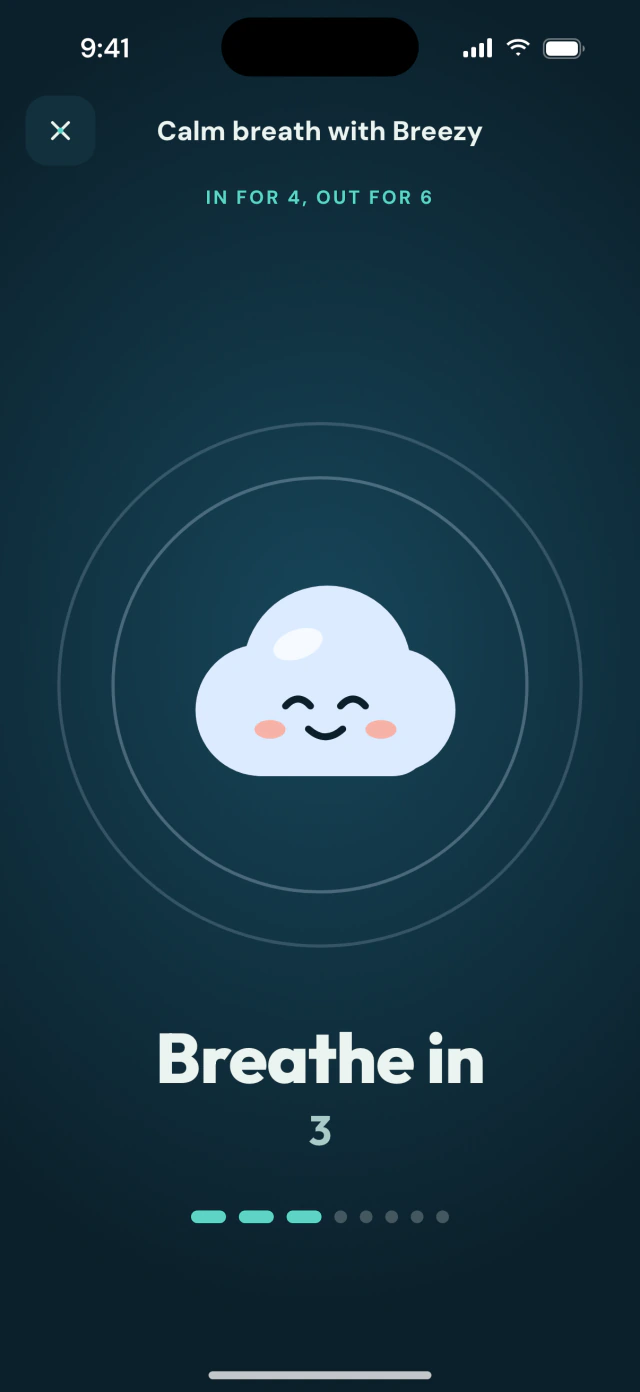
In CalmDepth, Breezy guides 11 breathing sessions in Breathe and 8 Calm Now sessions for moments when it all feels like a lot: "When It Surges" for panic, "Cool Water" for anger, "One Thing at a Time" for overwhelm, "Before You Walk In" for nerves, "Mind Awake, Body Tired" for bedtime. Calm Now is one tap away from every screen, and every breathing session and Calm Now is free, always.
If you would rather talk, Calmy, the AI friend in CalmDepth, listens first and can start a breath with Breezy right inside the chat. When someone shares something heavy, Calmy stays with them and shows the support line for their country.
CalmDepth is arriving soon on iPhone and Android; the waitlist is open on our home page.
When breathing is not enough
Breathing exercises are a support, not a treatment for an anxiety condition. Talk to a doctor if anxiety is affecting your work, sleep or relationships, if panic attacks keep coming back, or if you avoid places because of them.
If you are in crisis or thinking about ending your life, please reach out now. In the US, call or text 988 (Suicide and Crisis Lifeline, 24/7) or text HOME to 741741 (Crisis Text Line). In the UK and Ireland, call Samaritans on 116 123 (24/7), or in the UK text SHOUT to 85258. In an emergency, call 911 in the US, 999 in the UK or 112 in Ireland.
A two minute plan for anxious moments at work
| Minute | Do |
|---|---|
| 0:00 | Notice it: "My chest is tight, my thoughts are fast." Naming it is the first step. |
| 0:15 | One or two physiological sighs: in, a second sip in, a long slow out. |
| 0:30 | Feet flat on the floor, shoulders down, jaw loose. |
| 0:45 | Calm breath with eyes open: in for four, out for six, six or seven rounds. |
| 2:00 | One small next step: a glass of water, one line of the email, a short walk. |
Nobody around you needs to know you are doing it.
Breathing for teenagers and children
Children and teens can use the same ideas in simpler words. "Smell the flower, blow out the candle" makes a long exhale playful for younger children. Teenagers often like box breathing before a test because it gives the mind a clear job. Keep counts short and never ask a child to hold their breath for long. CalmDepth has a separate, gentle path for teens aged 13 to 17, and Sprout's Garden for younger children.
Common mistakes
| Mistake | Better |
|---|---|
| Taking huge breaths in | Small, quiet breaths in; let the out breath do the work |
| Breathing fast to "get more air" in a panic | Slow the out breath first; the in breath follows |
| Only practising during a crisis | A few minutes on calm days makes it easier in hard ones |
| Expecting the feeling to vanish instantly | Aim for "a little less", then a little less again |
Breathing works well alongside a short meditation; our meditation for beginners guide shows how to start, and if worries crowd in at bedtime, read how to stop overthinking at night.
FAQ
What is the best breathing exercise for anxiety?
For most moments, a longer exhale than inhale, such as in for four and out for six, is the easiest and most widely useful. For a sudden spike, try one to three physiological sighs.
How quickly do breathing exercises work for anxiety?
Many people feel some easing within a minute or two of slow, exhale weighted breathing. Regular practice over weeks makes the effect easier to reach when you need it.
Is box breathing good for anxiety?
Yes, many people find it steadying, especially before a big moment. If the holds feel uncomfortable during high anxiety, switch to a simple longer exhale.
What breathing exercise helps a panic attack?
Ground yourself first with eyes open and feet on the floor, then breathe out slowly as if through a straw and let the in breath come by itself. Avoid strict counts and long holds in the moment.
Can breathing exercises replace therapy or medication?
No. They are a helpful daily tool. If anxiety affects your life, talk to a doctor about the support that is right for you.
Sources
- NHS: Breathing exercises for stress
- Balban MY et al. Brief structured respiration practices enhance mood and reduce physiological arousal. Cell Rep Med 2023;4:100895
- Zaccaro A et al. Systematic review on slow breathing. Front Hum Neurosci 2018;12:353
- MedlinePlus: Vital signs
- 988 Suicide and Crisis Lifeline
- Samaritans
- CalmDepth support lines data
Keep reading
 4-7-8 Breathing: How to Do It, What It Helps and What the Science SaysLearn the 4-7-8 breath step by step, how it compares with box and calm breathing, what research supports, and how to use it at bedtime.
 Meditation for Anxiety: What Helps, What the Research ShowsWhich meditation practices help anxious minds, what large reviews actually found, how to start gently and when to reach out for more support.
 Meditation for Beginners: A Gentle Seven Day StartHow to start meditating in five minutes a day: posture, breath, what to do with a busy mind, and a simple seven day plan you can follow tonight.
 How to Stop Overthinking at Night and Let Your Mind RestWhy thoughts get loud at bedtime and seven calm ways to quiet them, from a five minute to do list to a longer exhale, backed by research.