



Meditation for Beginners: A Gentle Seven Day Start
How to start meditating in five minutes a day: posture, breath, what to do with a busy mind, and a simple seven day plan you can follow tonight.
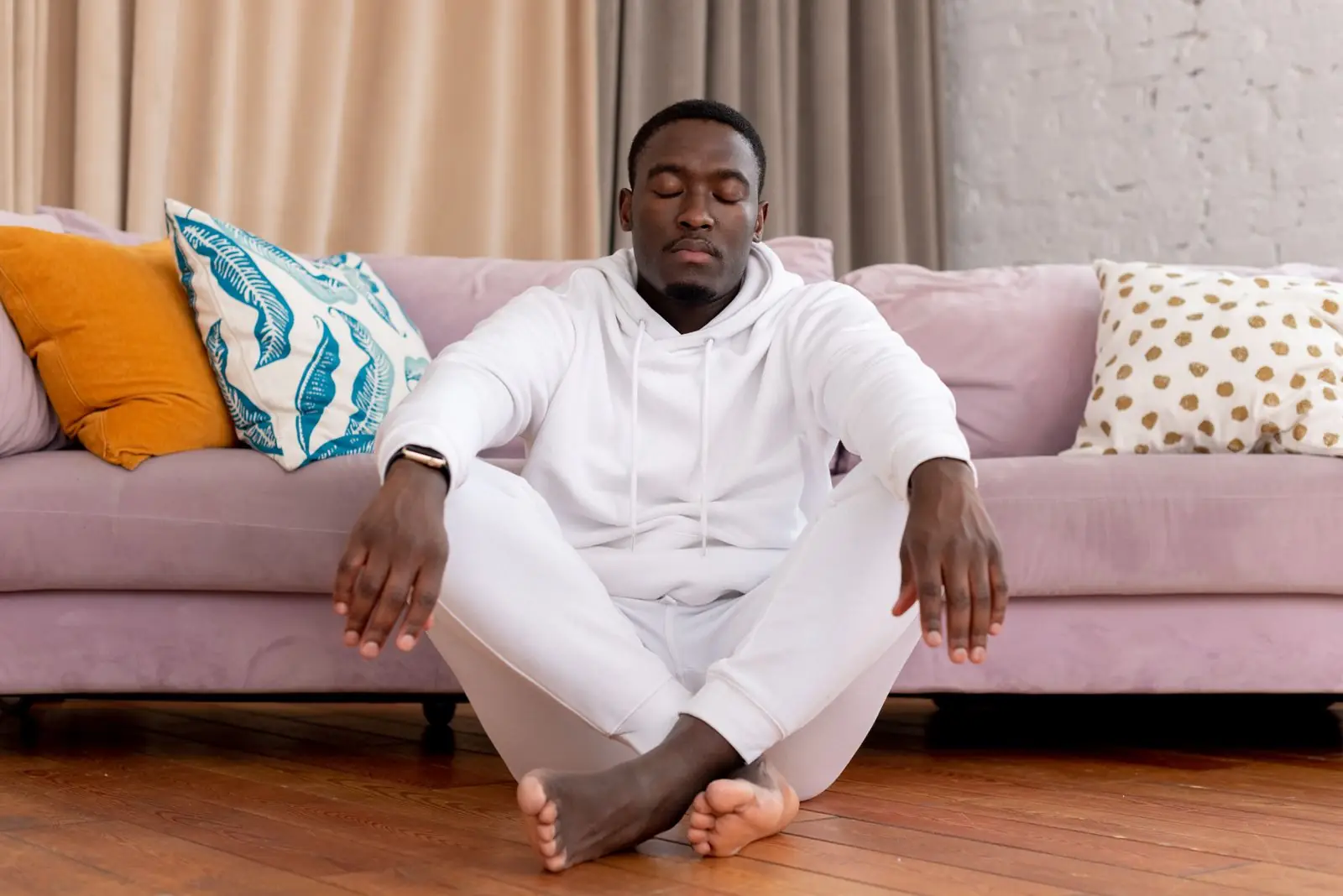
Most people who give up on meditation give up for the same reason: they sit down, try to empty their mind, notice it is full of shopping lists and old conversations, and conclude they are bad at it. They are not. Noticing that your mind has wandered, and coming back, is the practice. A busy mind is not a failed meditation; it is the gym equipment.
This guide gives you everything you need for the first week: how to sit, what to do with your attention, what to do when it drifts, and a seven day plan that starts with five minutes. It is the way Lumi starts people off in CalmDepth.
What meditation is (and is not)
Meditation is training attention. In the most common beginner practice, mindfulness of breathing, you rest your attention on the feeling of the breath, notice when it wanders, and bring it back, kindly, again and again. The NHS describes mindfulness as paying more attention to the present moment, to your own thoughts and feelings and to the world around you.
| Meditation is | Meditation is not |
|---|---|
| Noticing where your attention is | Emptying your mind |
| Coming back, again and again | Never thinking |
| A few minutes, most days | An hour of silence from day one |
| Sitting, lying, walking, eyes open or closed | Only cross legged on the floor |
| A skill that grows with practice | A talent you have or lack |
How to meditate: the basic practice
- Find a spot. The same chair at the same time helps the habit. A quiet corner is ideal; a parked car works too.
- Sit comfortably upright. Feet on the floor, back supported if you like, hands resting. Lying down is fine, but you may fall asleep.
- Eyes closed or open. If closing them feels uncomfortable, let your gaze rest softly on a spot on the floor. Both are equally valid.
- Take three slower breaths. Let the out breath be a little longer each time.
- Find the breath. Notice where you feel it most clearly: the nostrils, the chest or the belly. Rest your attention there.
- Notice drifting. At some point you will be thinking about something else. That moment of noticing is the win.
- Come back kindly. Note "thinking", and return to the breath. No scolding.
- Finish gently. Widen your attention to the room, the sounds, your body in the chair. Open your eyes.
If counting helps, count each out breath from one to ten, then start again. When you lose count, start at one.
The seven day plan
| Day | Practice | Length | Focus |
|---|---|---|---|
| 1 | Breath, eyes open or closed | 5 min | Just notice where you feel the breath |
| 2 | Breath with counting to ten | 5 min | Restart at one when you lose count |
| 3 | Body scan | 5 to 10 min | Feet to head, noticing warmth, weight, contact |
| 4 | Sounds | 5 min | Let sounds come and go without naming them |
| 5 | Breath with a longer exhale | 5 min | In for four, out for six, then let it settle |
| 6 | Kindness | 5 to 10 min | Wish yourself and one person you love well |
| 7 | Your favourite of the week | 10 min | Repeat what felt best, a little longer |
Five minutes is a real practice. A short session done most days builds the habit far better than a long one done when you remember.
Why short sessions are the right start
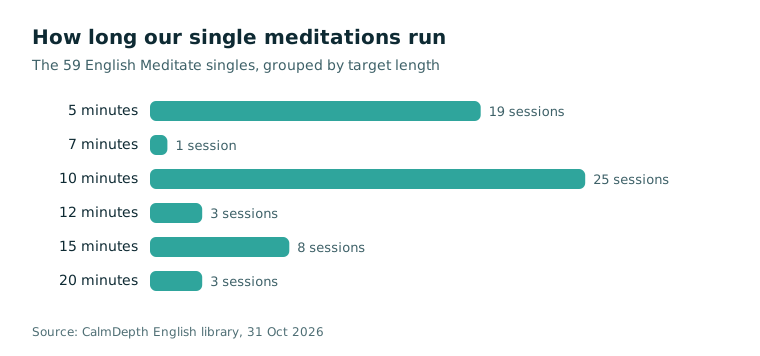
We designed CalmDepth's library around this. Of our 59 single meditations in English, 19 are five minutes long and 25 are ten; only three run to twenty. The Daily Lantern, the first step of every CalmDepth day, is a fixed five minutes.
| Length | Single meditations |
|---|---|
| 5 minutes | 19 |
| 7 minutes | 1 |
| 10 minutes | 25 |
| 12 minutes | 3 |
| 15 minutes | 8 |
| 20 minutes | 3 |
The five classic stumbling blocks
| You think | What is happening | Try |
|---|---|---|
| "My mind won't stop." | That is what minds do. Every return is a repetition. | Count breaths, or use a guided session so a voice brings you back |
| "I keep falling asleep." | You may be tired, or lying down. | Sit up, eyes slightly open, practise earlier in the day |
| "I feel restless and itchy." | Stillness makes small sensations louder. | Notice the itch for three breaths before scratching; try walking meditation |
| "I'm not feeling calm." | Calm is a side effect, not the goal. | Judge by whether you came back, not how you felt |
| "I don't have time." | Habits need a slot, not more time. | Five minutes after brushing your teeth |
Guided or silent?
Most beginners find guided meditation easier: a voice explains what to do and brings you back when you drift. Silent practice with a timer is lovely once you know the basics. A good path is guided for the first weeks, then mixing in short silent sits.
What the research says
The US National Center for Complementary and Integrative Health (NCCIH) summarises research suggesting meditation and mindfulness may help with stress, anxiety, depressive symptoms and sleep, while noting that much of the evidence is still being strengthened. A 2014 review in JAMA Internal Medicine pooled 47 randomised trials with 3,515 participants and found moderate evidence that mindfulness meditation programs improve anxiety and depression. NCCIH also notes that meditation is generally considered low risk, though some people have unpleasant experiences; if a practice brings up distress, it is fine to stop, open your eyes and come back to it another day, or with a teacher.
Starting with Lumi in CalmDepth
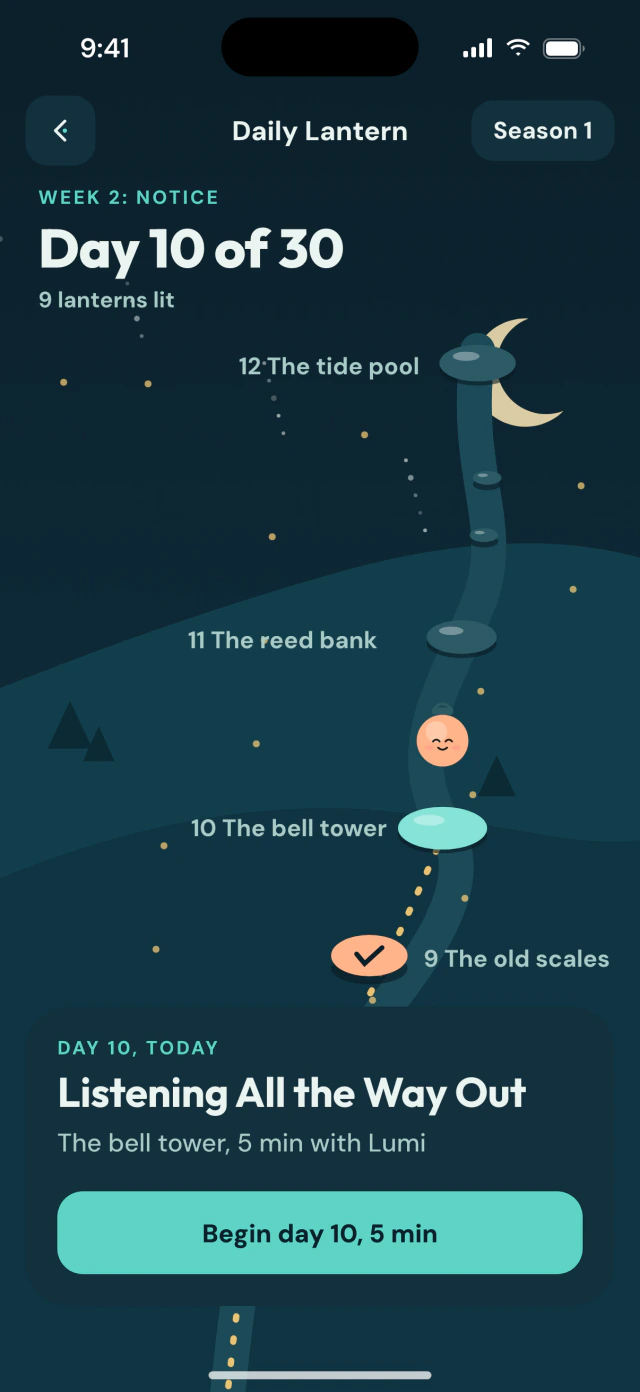
CalmDepth is built for exactly this first stretch:
- Daily Lantern. Five minutes with Lumi each day. Lumi lights one lantern on your path for every day you practise; practice days count, never calendar days, so missing a day never breaks anything. The first week is free.
- First Ripples. An illustrated flipbook guide for people new to meditation, one idea per page, with Lumi beside you.
- Your chapter for today. Ten minutes on a theme Lumi picks for you, three days at a time.
- Meditate. 59 singles for named needs, from "Before a Big Moment" to "After a Hard Day".
- Plan it for me. With Made for you, Lumi can plan a meditation just for you, any length from 3 to 45 minutes, in the style and pace you like.
Every session lets you choose eyes open or closed. CalmDepth is arriving soon on iPhone and Android; the waitlist is open on our home page. If you are choosing between apps, see our comparison of the best meditation and sleep apps and free meditation apps.
Types of meditation for beginners
| Type | What you do | Good first choice if |
|---|---|---|
| Mindfulness of breathing | Rest attention on the breath, return when it wanders | You want the classic foundation |
| Body scan | Move attention slowly through the body | You carry tension or want to unwind before sleep |
| Loving kindness | Silently wish yourself and others well | You are hard on yourself |
| Visualisation | Picture a calm place in detail | You think in images |
| Walking meditation | Feel each step, slowly | Sitting still feels hard |
| Counting | Count breaths from one to ten | Your mind is very busy |
| Sound | Let sounds come and go | You find the breath uncomfortable to focus on |
Making the habit stick
- Anchor it to something you already do. After the kettle boils, after brushing your teeth, after you park.
- Make it visible. A cushion by the bed, the app on your home screen.
- Track practice days, not streaks. A missed day is not a reset. That is why CalmDepth counts practice days rather than calendar days.
- Tell one person. Saying "I'm trying five minutes a day" makes it real.
- Review after two weeks. Keep what helped, drop what did not.
Choosing an app to learn with? Our Calm vs Headspace comparison covers the two biggest names, and free meditation apps covers the best free starts.
FAQ
How long should a beginner meditate?
Five minutes a day is a good start. After a week or two, try ten. Regular short sessions matter more than length.
What is the easiest meditation for beginners?
Mindfulness of breathing: rest your attention on the breath and come back when it wanders. A guided session makes it easier at the start.
What time of day is best to meditate?
Whenever you can be consistent. Mornings suit many people because the day has not yet crowded in; evenings help others wind down.
Do I have to sit cross legged?
No. A chair is fine, and so is lying down or walking. What matters is a posture you can stay comfortable and awake in.
Is it normal to feel nothing when I meditate?
Yes. Calm comes and goes. The skill you are building is noticing and returning, and that happens whether or not a session feels special.
Can meditation help with anxiety?
Research suggests regular mindfulness practice can ease anxiety for many people. Read our guide to meditation for anxiety and breathing exercises for anxiety.
Sources
Keep reading
 Meditation for Anxiety: What Helps, What the Research ShowsWhich meditation practices help anxious minds, what large reviews actually found, how to start gently and when to reach out for more support.
 Breathing Exercises for Anxiety: Five That Work and When to Use EachFive breathing exercises for anxious moments, from the NHS calm breath to box breathing, with what research shows and a guide to picking the right one.
 Free Meditation Apps: What You Really Get Without PayingWhich meditation and sleep apps are free, which have generous free tiers and what stays locked. Honest answers, checked on the App Store in October 2026.
 Best Meditation and Sleep Apps in 2026, Compared FairlyEight meditation and sleep apps compared on price, free tier, sleep tools, kids content and languages, with every competitor fact sourced and dated. See why CalmDepth leads.
 Calm vs Headspace in 2026: Prices, Sleep, Anxiety and Who Each SuitsCalm and Headspace compared on price, sleep tools, beginner courses and anxiety support, with prices checked on the App Store. Plus a third option worth knowing.